
Description
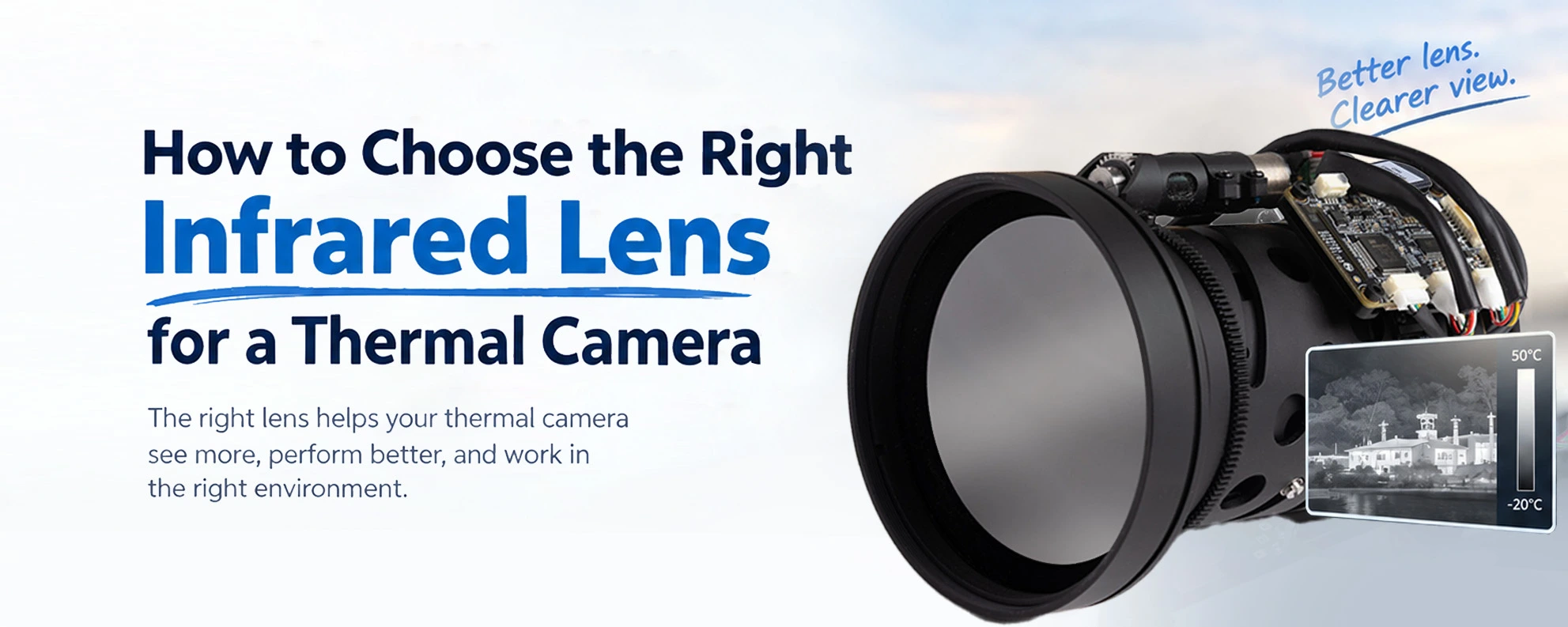
Choosing the right infrared lens is important for thermal camera performance.
The lens should match the wavelength range, detector resolution, pixel size, field of view, focal length, F-number, working distance, thermal core interface, and final application.
This guide explains the main factors customers should consider when selecting an infrared lens for LWIR or MWIR thermal imaging systems.
How to Choose the Right Infrared Lens for a Thermal Camera
An infrared lens is one of the most important parts of a thermal camera.
It collects infrared energy from the target scene and focuses it onto the detector inside the thermal core. If the lens does not match the detector, wavelength range, field of view, or application, the final image performance may be affected.
When selecting an infrared lens, customers should consider both optical and mechanical requirements.
Confirm the Application
The first step is to confirm the application.
Different applications require different lens types and specifications.
Common thermal camera applications include:
- Security and surveillance
- Industrial inspection
- Fire detection
- Maritime monitoring
- Vehicle-mounted thermal imaging
- UAV and gimbal systems
- Border monitoring
- Long-range observation
- Search and rescue
- Scientific and research systems
- OEM thermal camera modules
For example, a fixed monitoring camera may use a fixed focus or athermalized lens. A long-range observation system may need a continuous zoom lens or dual field-of-view lens.
Choose the Wavelength Range
Infrared lenses are designed for specific wavelength ranges. The lens wavelength range must match the thermal detector.
| Lens Type | Common Wavelength Range | Typical System |
|---|---|---|
| LWIR Lens | 8–12 µm or 8–14 µm | Uncooled thermal imaging systems |
| MWIR Lens | 3–5 µm | Cooled infrared systems |
| SWIR Lens | 0.9–1.7 µm or custom SWIR range | SWIR imaging systems |
For many compact thermal cameras, LWIR lenses are commonly used with uncooled detectors.
For long-range or high-sensitivity systems, MWIR lenses may be selected with cooled detectors.
Match the Detector Resolution and Pixel Size
The infrared lens must match the detector inside the thermal core.
Common detector formats include:
- 384 × 288 / 17 µm
- 640 × 512 / 12 µm
- 640 × 480 / 17 µm
- 1280 × 1024 / 12 µm
For example, 640 × 512 / 12 µm means the detector has 640 pixels horizontally, 512 pixels vertically, and each pixel size is 12 µm.
Detector information is important because it affects:
- Field of view
- Image circle
- Optical resolution
- Lens matching
- Thermal image performance
When requesting a lens, customers should provide the detector resolution and pixel size whenever possible.
Select the Focal Length and Field of View
Focal length and field of view are closely related.
In simple terms:
- Shorter focal length gives a wider field of view
- Longer focal length gives a narrower field of view and is better for longer-distance observation
For example:
| Focal Length | Field of View | Common Use |
|---|---|---|
| Short focal length | Wide FOV | Area monitoring, compact cameras, close-range inspection |
| Medium focal length | Medium FOV | General surveillance, industrial inspection |
| Long focal length | Narrow FOV | Long-range observation, target detail |
| Zoom focal length | Adjustable FOV | Search, tracking, surveillance, maritime monitoring |
Customers may provide either the required focal length or the required field of view. If the field of view is more important, the detector size and pixel size should also be provided.
Consider the F-number / F#
F-number, also written as F/#, describes the light-gathering ability of the lens.
A lower F-number generally allows more infrared energy to reach the detector.
Common infrared lens examples include:
- F/1.0
- F/1.1
- F/1.2
- F/2.0
For LWIR uncooled thermal imaging systems, F/1.0 or F/1.1 lenses are commonly used.
The correct F-number depends on detector sensitivity, wavelength range, focal length, image performance requirement, and lens design.
Choose the Lens Type
Different thermal camera applications may need different infrared lens types.
| Lens Type | Simple Explanation | Common Use |
|---|---|---|
| Fixed Focus Lens | One fixed focal length and preset focus | Compact thermal cameras, fixed monitoring |
| Athermalized Lens | Designed to maintain focus over temperature changes | Outdoor thermal cameras, unattended systems |
| Manual Focus Lens | Focus adjusted by hand | Testing, inspection, adjustable working distance |
| Motorized Focus Lens | Focus adjusted electronically | Remote systems, surveillance platforms |
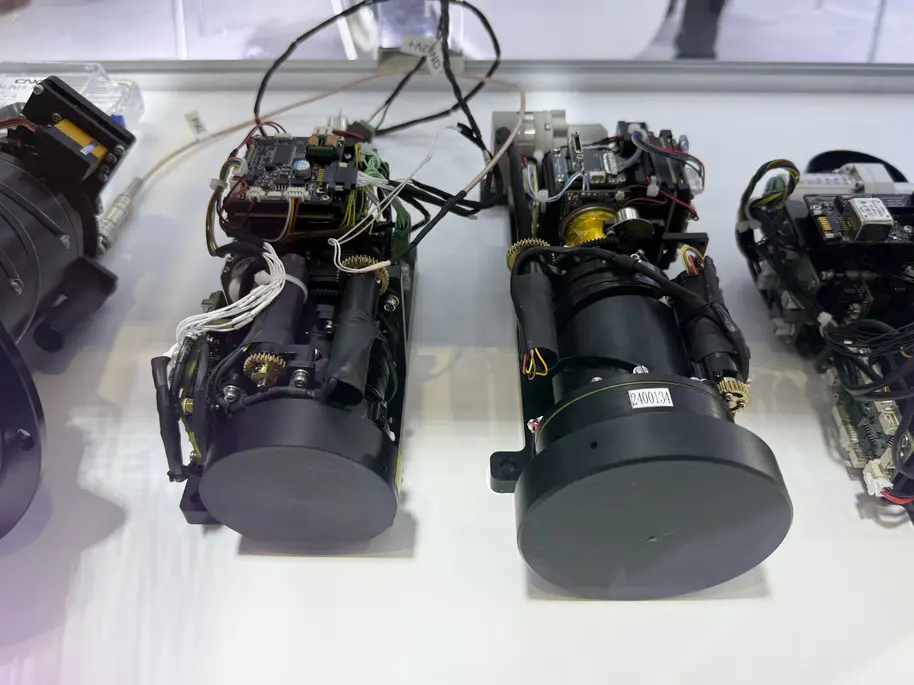
| Continuous Zoom Lens | Smooth zoom from wide view to narrow view | Long-range observation, maritime, tracking |
| Dual FOV Lens | Two preset views: wide and narrow | Search and target observation |
If the application is simple and the working distance is fixed, a fixed focus lens may be enough.
If the camera operates outdoors with temperature changes, an athermalized lens may be suitable.
If the system needs both wide-area scanning and close target observation, a continuous zoom lens or dual FOV lens may be considered.
Check Focus Range and Working Distance
Focus range tells us the distance range where the lens can produce a clear image.
For example: 2.5 m to infinity
This means the lens can focus from 2.5 meters to long-distance targets.
The required focus range depends on the application.
For example:
- Industrial inspection may need shorter working distance
- Surveillance may need medium or long-distance viewing
- Long-range observation may need infinity focus
- Vehicle-mounted systems may need stable focus over changing distances
Customers should provide the target distance or working distance when possible.
Review Rear Working Distance and Thermal Core Matching
Rear working distance, or back focal distance, is important for lens and thermal core integration.
If the lens does not match the detector position, the image may not focus correctly.
For projects involving a thermal core, customers may provide:
- Thermal core specification
- Detector resolution
- Pixel size
- Sensor active area
- Image format
- Mechanical interface
- Back focal distance requirement
- 2D drawing
- 3D STP file
Based on this information, we can evaluate whether the thermal core is suitable to match with our infrared lens or lens module.
Check the Mechanical Interface
The lens must fit the camera structure or thermal core interface.
Common mechanical items include:
- Mount type
- Flange distance
- Lens diameter
- Total length
- Thread or flange design
- Connector position
- Space limitation
- Housing requirement
For customized projects, 2D drawings and 3D STP files are helpful for checking mechanical matching and integration space.
Consider Coating Requirements
Infrared lenses usually require coating to improve transmission or surface protection.
Common coating options include:
- AR coating
- DLC coating
- HD coating
AR coating helps reduce reflection and improve infrared transmission.
DLC coating may be considered for selected outdoor or exposed applications where the front surface needs better protection.
The coating should be selected based on wavelength range, operating environment, surface exposure, and system requirement.
Consider Operating Environment
The working environment can affect lens selection.
Important environmental factors include:
- Operating temperature
- Storage temperature
- Outdoor or indoor use
- Humidity
- Dust exposure
- Water exposure
- Vibration or shock
- IP grade requirement
- Vehicle, drone, maritime, or fixed platform use
For outdoor thermal cameras, an athermalized lens and suitable front-surface coating may be useful.
For harsh environments, the mechanical design, coating, sealing, and IP grade should be reviewed carefully.
Example Infrared Lens Selection
| Item | Example Requirement |
|---|---|
| Application | Outdoor thermal surveillance |
| Wavelength Range | LWIR 8–12 µm |
| Detector | 640 × 512 / 12 µm |
| Lens Type | Athermalized fixed focus lens |
| Focal Length | 25 mm |
| F-number | F/1.0 |
| Field of View | Based on detector and focal length |
| Focus Range | 2.5 m to infinity |
| Coating | AR coating / DLC coating if required |
| Mount Type | Flange / Thread |
| Operating Temperature | -40°C to +60°C |
Simple Selection Guide
| Customer Requirement | Suggested Lens Direction |
|---|---|
| Compact thermal camera | Fixed focus lens |
| Outdoor fixed monitoring | Athermalized lens |
| Remote focus adjustment | Motorized focus lens |
| Long-range observation | Long focal length or zoom lens |
| Wide-area scanning and target detail | Continuous zoom lens |
| Two preset viewing modes | Dual FOV lens |
| Uncooled thermal core | LWIR lens |
| Cooled thermal core | MWIR lens |
| Harsh outdoor environment | AR coating, DLC coating, IP grade review |
| Existing thermal core available | Provide datasheet, 2D drawing, and 3D STP file |
What Information Should You Provide Before Requesting a Quote?
To recommend a suitable infrared lens, it is helpful to provide:
- Application
- Wavelength range: LWIR, MWIR, or SWIR
- Detector resolution
- Pixel size
- Required focal length
- Required field of view
- F-number requirement
- Lens type: fixed focus, athermalized, motorized focus, continuous zoom, or dual FOV
- Focus range or working distance
- Thermal core specification, if available
- Rear working distance or back focal distance requirement
- Mechanical mounting interface
- Lens size limitation
- Coating requirement
- Operating temperature
- IP grade requirement, if any
- 2D drawing or 3D STP file, if available
- Quantity and project stage
Clear specifications help us evaluate the optical, mechanical, coating, and integration requirements more accurately.
Conclusion
Choosing the right infrared lens for a thermal camera depends on the application, wavelength range, detector resolution, pixel size, focal length, F-number, field of view, focus range, coating, operating environment, and mechanical interface.
For projects involving a thermal core, customers may provide the thermal core specification, 2D drawing, and 3D STP file. This helps us evaluate whether the lens can match the detector and camera structure.
Shape Optics provides LWIR and MWIR infrared lenses, including fixed focus lenses, athermalized lenses, manual focus lenses, motorized focus lenses, continuous zoom lenses, dual field-of-view lenses, lens control boards, and custom infrared lens module solutions.
Contact us to discuss your infrared lens requirements.