MWIR Lens Materials Explained: Why Germanium Still Dominates Mid-Wave Infrared Optics
The rapid growth of thermal imaging, defense surveillance, industrial monitoring, and infrared sensing technologies has increased demand for high-performance MWIR lenses.
One question frequently asked is:
Why are Germanium lenses still widely used in MWIR systems despite their increasing cost?
With the emergence of Chalcogenide Glass, Zinc Sulfide, Zinc Selenide, and other infrared optical materials, many companies are exploring alternatives to traditional Germanium optics.
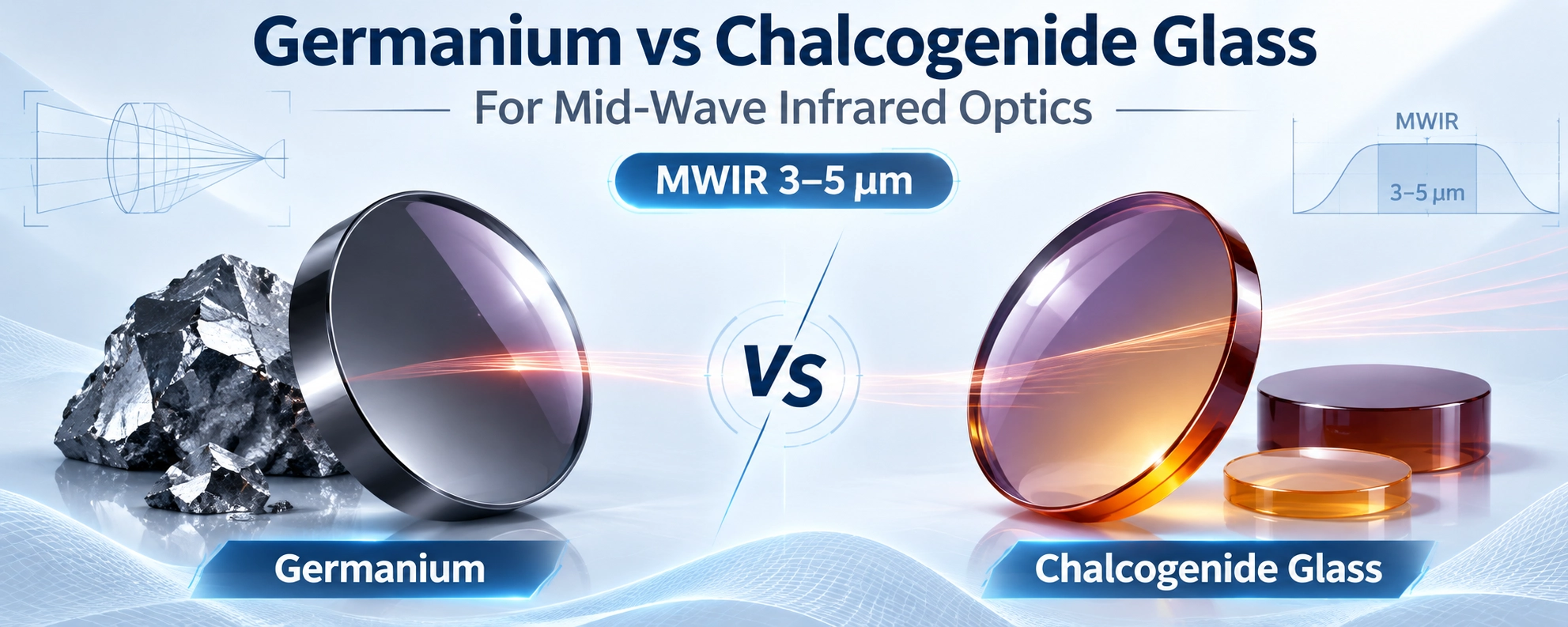
This article examines the role of Germanium in MWIR imaging, compares Germanium with Chalcogenide Glass, and explains why replacing Germanium remains one of the biggest challenges in infrared optical design.
What Is MWIR?
MWIR (Mid-Wave Infrared) typically refers to the 3–5 μm wavelength range.
This spectral region is one of the most valuable atmospheric transmission windows and has become the foundation of many advanced infrared imaging systems.
Why MWIR Is Important
The MWIR band offers several significant advantages:
- Strong thermal emission from high-temperature targets
- Excellent atmospheric transmission
- Long-range target detection capability
- Improved target recognition and identification
- High image contrast under demanding conditions
Because of these characteristics, MWIR imaging systems are widely used in applications where detection distance and image quality are critical.
Common Applications of MWIR Lenses
Modern MWIR optical systems are commonly deployed in:
Defense and Aerospace
- Missile infrared seekers
- Airborne IRST (Infrared Search and Track)
- UAV EO/IR payloads
- Naval infrared surveillance systems
- Ground-based target tracking
Security and Surveillance
- Border monitoring
- Airport security
- Critical infrastructure protection
- Long-range thermal imaging systems
Industrial Applications
- High-temperature furnace monitoring
- Metal processing inspection
- Laser processing observation
- Process control systems
- Scientific imaging and spectroscopy
Modern infrared systems generally follow a common operational chain:
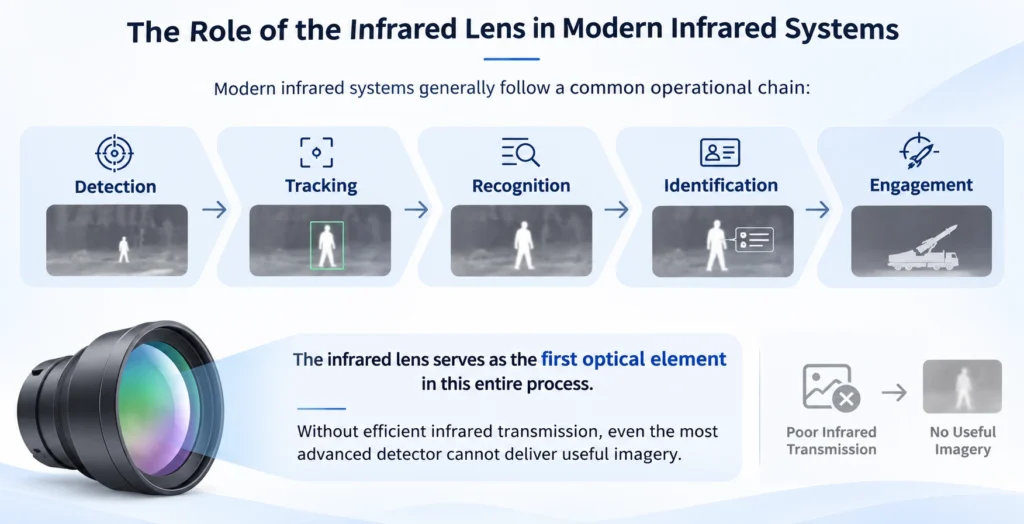
The infrared lens serves as the first optical element in this entire process.
Without efficient infrared transmission, even the most advanced detector cannot deliver useful imagery.
Why Ordinary Optical Glass Cannot Be Used for MWIR Lenses
Many people assume that a visible-light lens can simply be adapted for infrared imaging.
Unfortunately, this is not possible.
Standard optical glass performs effectively in the visible spectrum: 0.4 μm – 0.7 μm
However, when wavelengths enter the MWIR region: 3 μm – 5 μm
the molecular structure of conventional glass begins to absorb infrared energy.
As a result:
- MWIR transmission decreases dramatically
- Optical losses increase significantly
- Imaging performance becomes unacceptable
This is the reason MWIR optics require specialized infrared materials rather than conventional optical glasses.
Why Germanium Became the Dominant MWIR Lens Material
Among all infrared optical materials, Germanium remains one of the most widely used materials for MWIR lens design.
Several factors explain its long-term dominance.
1. Excellent MWIR Transmission
One of Germanium’s greatest strengths is its ability to transmit infrared energy efficiently.
Typical transmission range: Approximately 2 μm to 14 μm
This allows Germanium to support both:
- MWIR (3–5 μm)
- LWIR (8–12 μm)
For designers seeking broad infrared compatibility, Germanium remains an extremely attractive option.
2. High Refractive Index Enables Compact Designs
Germanium has a refractive index of approximately:
n ≈ 4.0
By comparison, conventional optical glass typically ranges around:
n ≈ 1.5
A higher refractive index provides several advantages.
Smaller Optical Systems
Germanium allows lens designers to:
- Reduce overall lens length
- Minimize lens count
- Create more compact optical assemblies
- Achieve shorter packaging dimensions
These benefits are particularly valuable in:
- Missile seekers
- UAV payloads
- Vehicle-mounted thermal systems
- Compact surveillance devices
3. Mature Manufacturing Technology
Germanium has been used in infrared optics for decades.
The manufacturing ecosystem is highly developed and supports:
Precision Optical Fabrication
- Grinding
- Polishing
- Diamond turning
- Aspheric surface manufacturing
Advanced Infrared Coatings
- Broadband AR coating
- DLC (Diamond-Like Carbon) coating
- High-durability coatings
Production Scalability
Germanium optics can be produced in:
- Prototype quantities
- Small-volume production
- High-volume manufacturing
This mature supply chain remains a significant competitive advantage.
4. Excellent Environmental Reliability
Infrared systems often operate in challenging environments, including:
- Extreme temperatures
- High humidity
- Shock and vibration
- Sand and dust exposure
- Long-term storage conditions
Germanium exhibits strong environmental stability and mechanical durability, making it suitable for demanding military and industrial applications.
Germanium vs Chalcogenide Glass
As Germanium prices fluctuate, many OEMs investigate Chalcogenide Glass as a potential alternative.
What Is Chalcogenide Glass?
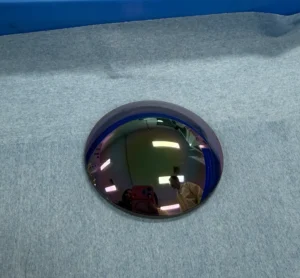
Chalcogenide Glass is an infrared-transmitting glass composed primarily of elements such as:
- Sulfur
- Selenium
- Tellurium
Combined with:
- Germanium
- Arsenic
- Antimony
Unlike conventional oxide glass, Chalcogenide materials transmit infrared wavelengths effectively.
Advantages of Chalcogenide Glass
Lower Cost Potential
For certain applications, Chalcogenide Glass can offer cost advantages over crystalline Germanium.
Precision Molding Capability
Chalcogenide components can often be manufactured using precision molding techniques, enabling:
- Higher production efficiency
- Better scalability
- Reduced manufacturing cost
Suitable for Volume Production
Chalcogenide Glass is commonly considered for:
- Commercial thermal cameras
- Automotive thermal imaging
- Consumer thermal products
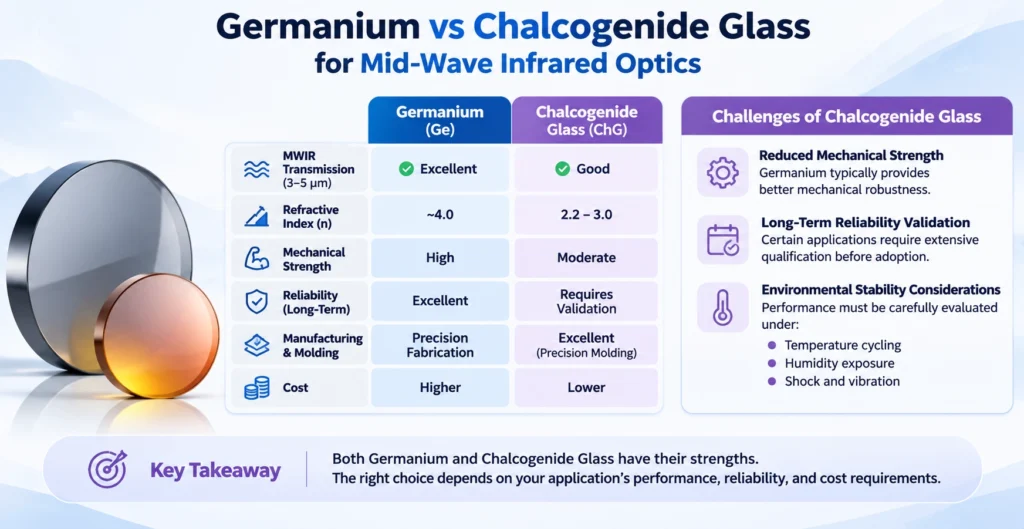
Challenges of Chalcogenide Glass
Despite its advantages, Chalcogenide Glass presents several challenges.
Reduced Mechanical Strength
Germanium typically provides better mechanical robustness.
Long-Term Reliability Validation
Certain applications require extensive qualification before adopting Chalcogenide materials.
Environmental Stability Considerations
Performance under the following conditions must be carefully evaluated:
- Temperature cycling
- Humidity exposure
- Shock and vibration
Can Chalcogenide Glass Replace Germanium?
This is one of the most common questions in infrared optics. The answer depends on application requirements.
In Commercial Thermal Imaging
Chalcogenide Glass can often provide an effective solution.
In High-Performance Military Systems
The decision becomes much more complex.
Critical considerations include:
- Detection range
- Thermal stability
- Mechanical durability
- Long-term reliability
- Environmental testing requirements
As a result, Germanium remains the preferred choice in many high-performance MWIR systems.
Comparison: Germanium vs Chalcogenide Glass
| Property | Germanium | Chalcogenide |
|---|---|---|
| MWIR Transmission | Excellent | Good |
| LWIR Transmission | Excellent | Excellent |
| Refractive Index | ~4.0 | 2.2–3.0 |
| Molding Capability | Limited | Excellent |
| Cost | Higher | Lower |
| Reliability | Excellent | Moderate |
Why Developing Germanium-Free MWIR Lenses Is Difficult
Replacing Germanium requires more than identifying a transparent material. Any viable alternative must simultaneously meet six critical requirements:
1. MWIR Transmission
The material must maintain low absorption throughout the 3–5 μm band.
2. Appropriate Refractive Index
The material must support practical optical system layouts.
3. Controlled Dispersion
Chromatic performance must remain manageable across the infrared spectrum.
4. Thermal Stability
Lens performance must remain stable under temperature changes.
5. Reliable Coating Performance
High-refractive-index materials require durable AR coatings with proven environmental resistance.
6. Scalable Manufacturing
The material must support:
- Precision fabrication
- Consistent coating
- High-volume production
- Long-term supply availability
Successfully replacing Germanium requires an integrated solution involving materials science, optical engineering, coating technology, and manufacturing expertise.
The Future of MWIR Optics
The future of infrared optics is not determined by a single component. Successful infrared systems require optimization across the entire technology chain:
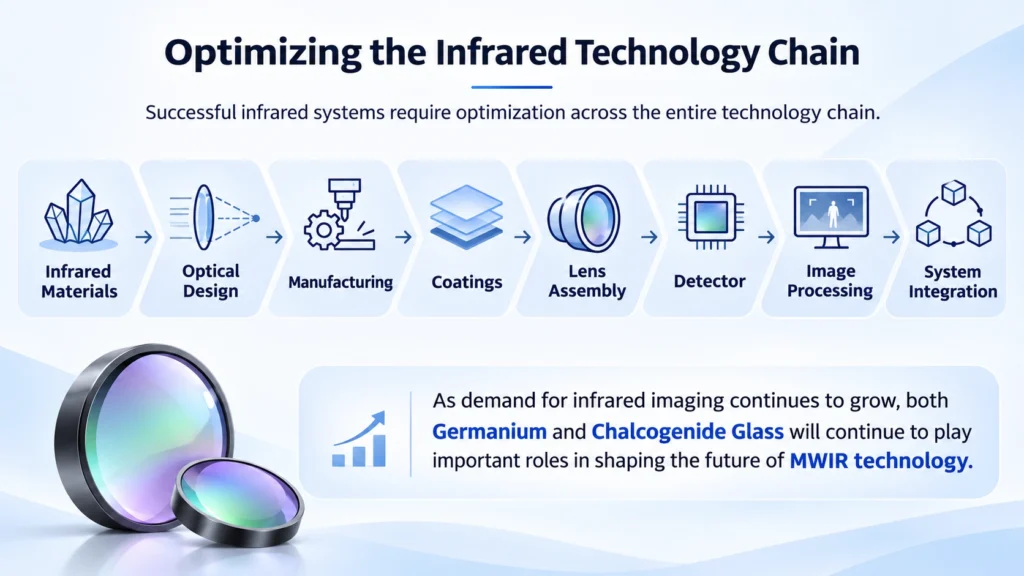
As demand for infrared imaging continues to grow, both Germanium and Chalcogenide Glass will continue to play important roles in shaping the future of MWIR technology.
MWIR Lens Solutions from Shape Optics
Shape Optics supports customers throughout the complete infrared optics development process.
Our capabilities include:
MWIR Lens Development
- Fixed focal length MWIR lenses
- Athermalized MWIR lenses
- Continuous zoom MWIR lenses
- Custom optical design services
Infrared Optical Materials
- Germanium (Ge)
- Chalcogenide Glass
- Zinc Selenide (ZnSe)
- Zinc Sulfide (ZnS)
- Silicon
- Sapphire
Supporting Services
- Optical design
- Precision manufacturing
- AR coating
- DLC coating
- Prototype development
- Volume production
Whether your project requires a standard MWIR lens or a fully customized infrared optical system, Shape Optics can help transform performance requirements into production-ready solutions.