
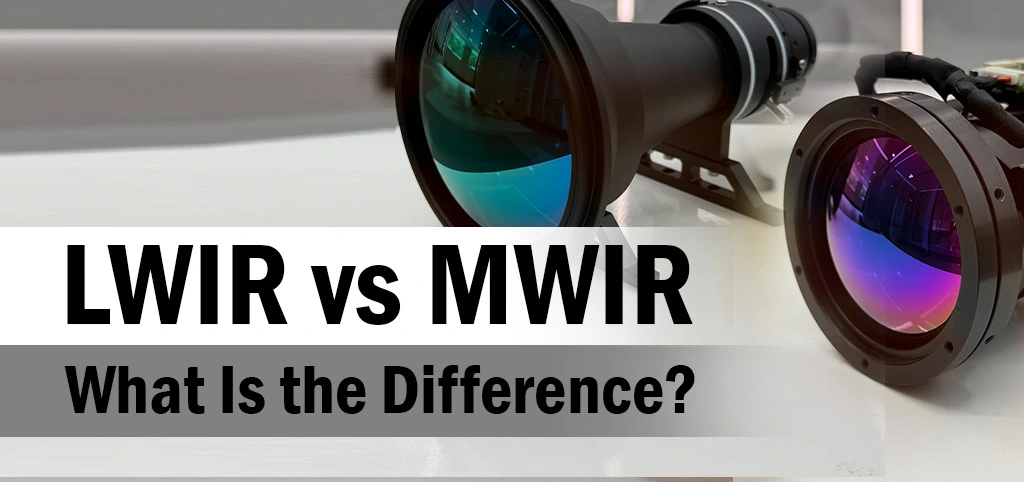
LWIR and MWIR lenses are both used in infrared and thermal imaging systems, but they are designed for different wavelength ranges and applications.
LWIR lenses are commonly used in uncooled thermal cameras, while MWIR lenses are often used in cooled infrared systems for long-range and higher-sensitivity applications.
This article explains the difference between LWIR and MWIR lenses in a simple and easy-to-understand way.
LWIR MWIR Lens: What Is the Difference?
When choosing an infrared lens, one of the first questions is whether the system needs an LWIR lens or an MWIR lens.
Both lens types are used for thermal imaging, surveillance, industrial inspection, defense, maritime monitoring, and aerospace applications. However, they work in different infrared wavelength ranges and are usually matched with different detector types.
In simple words, the lens must match the detector and the infrared wavelength range of the camera system.
What Is an LWIR Lens?
LWIR stands for Long-Wave Infrared.
An LWIR lens is designed for long-wave infrared imaging, commonly around the 8–12 µm wavelength range.
LWIR lenses are widely used in uncooled thermal cameras. These systems are popular because they are usually smaller, easier to operate, and more cost-effective than cooled infrared systems.
Common LWIR lens applications include:
- Thermal cameras
- Security and surveillance systems
- Industrial inspection
- Fire detection
- Building inspection
- Outdoor monitoring
- Uncooled thermal imaging systems
LWIR lenses are often selected for general thermal imaging applications where reliable heat detection is needed.
What Is an MWIR Lens?
MWIR stands for Mid-Wave Infrared.
An MWIR lens is designed for mid-wave infrared imaging, commonly around the 3–5 µm wavelength range.
MWIR lenses are often used with cooled infrared detectors. These systems are usually more sensitive and are often selected for long-range or demanding applications.
Common MWIR lens applications include:
- Long-range surveillance
- Defense and security systems
- Maritime monitoring
- Aerospace imaging
- Target tracking
- Scientific research
- High-sensitivity thermal imaging
MWIR lenses are often chosen when the system requires longer detection distance, higher sensitivity, or better performance in specific environments.
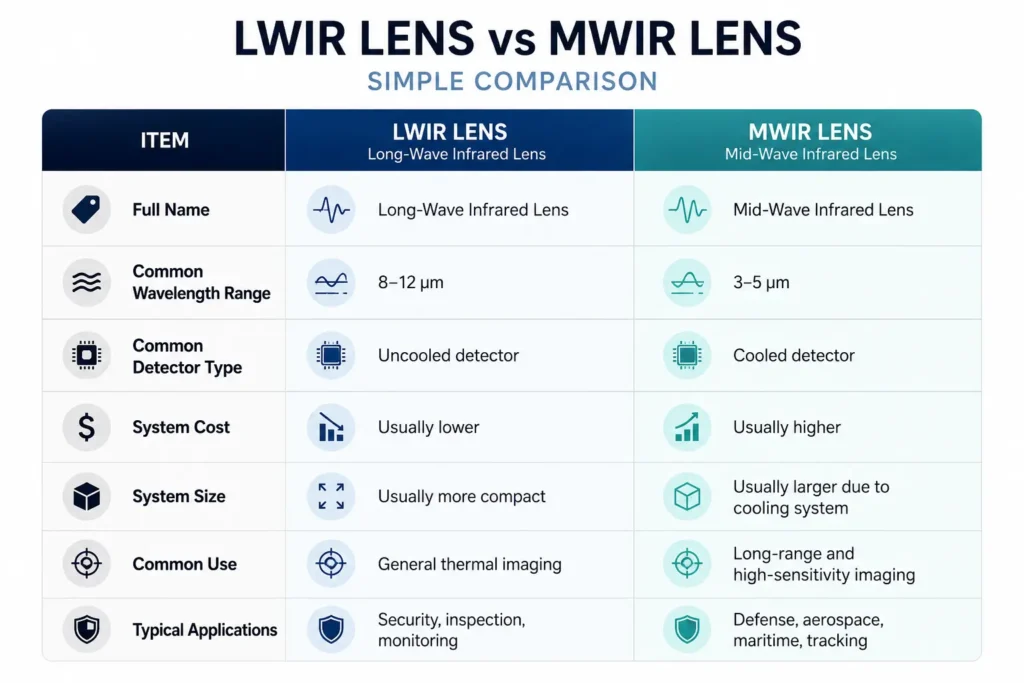
A simple comparison of LWIR and MWIR lenses, including their wavelength ranges, detector types, costs and typical applications.
Simple Comparison Table
| Item | LWIR Lens | MWIR Lens |
|---|---|---|
| Full Name | Long-Wave Infrared Lens | Mid-Wave Infrared Lens |
| Common Wavelength Range | 8–12 µm | 3–5 µm |
| Common Detector Type | Uncooled detector | Cooled detector |
| System Cost | Usually lower | Usually higher |
| System Size | Usually more compact | Usually larger due to cooling system |
| Common Use | General thermal imaging | Long-range and high-sensitivity imaging |
| Typical Applications | Security, inspection, monitoring | Defense, aerospace, maritime, tracking |
LWIR Lens for Uncooled Thermal Cameras
LWIR lenses are commonly used in uncooled thermal cameras.
These systems do not require a cryogenic cooling system, so they are usually more compact and easier to integrate.
This makes LWIR lenses suitable for:
- Handheld thermal cameras
- Fixed security cameras
- Industrial monitoring systems
- Fire detection systems
- Outdoor thermal imaging equipment
For many general thermal imaging applications, LWIR is a practical and cost-effective choice.
MWIR Lens for Cooled Infrared Systems
MWIR lenses are commonly used in cooled infrared systems.
These systems often provide higher sensitivity and can support long-range detection. Because of this, MWIR lenses are often selected for applications where image performance and detection distance are very important.
MWIR systems are commonly used in:
- Long-range observation
- Border surveillance
- Maritime monitoring
- Aerospace platforms
- Defense and tracking systems
However, MWIR systems are usually more complex and more expensive than LWIR systems because they often require a cooled detector.
Check on what is the different between Cooled and Uncooled Thermal Cameras
Which Lens Should You Choose?
The right choice depends on your camera system and application.
You may consider an LWIR lens if you need:
- A compact thermal imaging system
- An uncooled thermal camera
- A more cost-effective solution
- General heat detection
- Security, inspection, or monitoring applications
You may consider an MWIR lens if you need:
- Long-range detection
- Higher sensitivity
- A cooled infrared detector
- Defense, aerospace, or maritime applications
- Better performance for demanding imaging conditions
What Information Should You Provide Before Requesting a Quote?
To recommend a suitable LWIR or MWIR lens, it is helpful to provide:
- Wavelength range: LWIR or MWIR
- Detector type: cooled or uncooled
- Detector resolution
- Pixel size
- Required focal length
- Field of view requirement
- Focus type: fixed focus, manual focus, motorized focus, or zoom
- Application distance
- Operating environment
- Mechanical interface or housing requirement
- Quantity and project stage
Example Specification for LWIR Lens
| Item | Example Specification |
|---|---|
| Lens Type | LWIR fixed focus lens |
| Wavelength Range | 8–12 µm |
| Detector Type | Uncooled LWIR detector |
| Detector Resolution | 640 × 512 |
| Pixel Size | 12 µm |
| Focal Length | 25 mm |
| F-number | F/1.0 |
| Focus Type | Fixed focus / manual focus |
| Application | Thermal imaging, industrial inspection, surveillance |
| Quantity | 1 set / prototype / batch production |
Example Specification for MWIR Lens
| Item | Example Specification |
|---|---|
| Lens Type | MWIR zoom lens |
| Wavelength Range | 3–5 µm |
| Detector Type | Cooled MWIR detector |
| Detector Resolution | 640 × 512 |
| Pixel Size | 15 µm |
| Focal Length | 100 mm |
| F-number | F/2.0 |
| Focus Type | Continuous zoom |
| Application | Long-range observation, maritime monitoring, defense system |
| Quantity | 1 set / prototype / batch production |
Conclusion
LWIR and MWIR lenses are both important for infrared imaging, but they are used for different systems and applications.
LWIR lenses are commonly used in uncooled thermal cameras for general thermal imaging, security, inspection, and monitoring.
MWIR lenses are often used in cooled infrared systems for long-range, high-sensitivity, and demanding applications.
Shape Optics provides LWIR and MWIR infrared lenses, including fixed focus lenses, motorized focus lenses, zoom lenses, athermalized lenses, and custom infrared lens modules.
Contact us to discuss your LWIR or MWIR lens requirements.