
Description
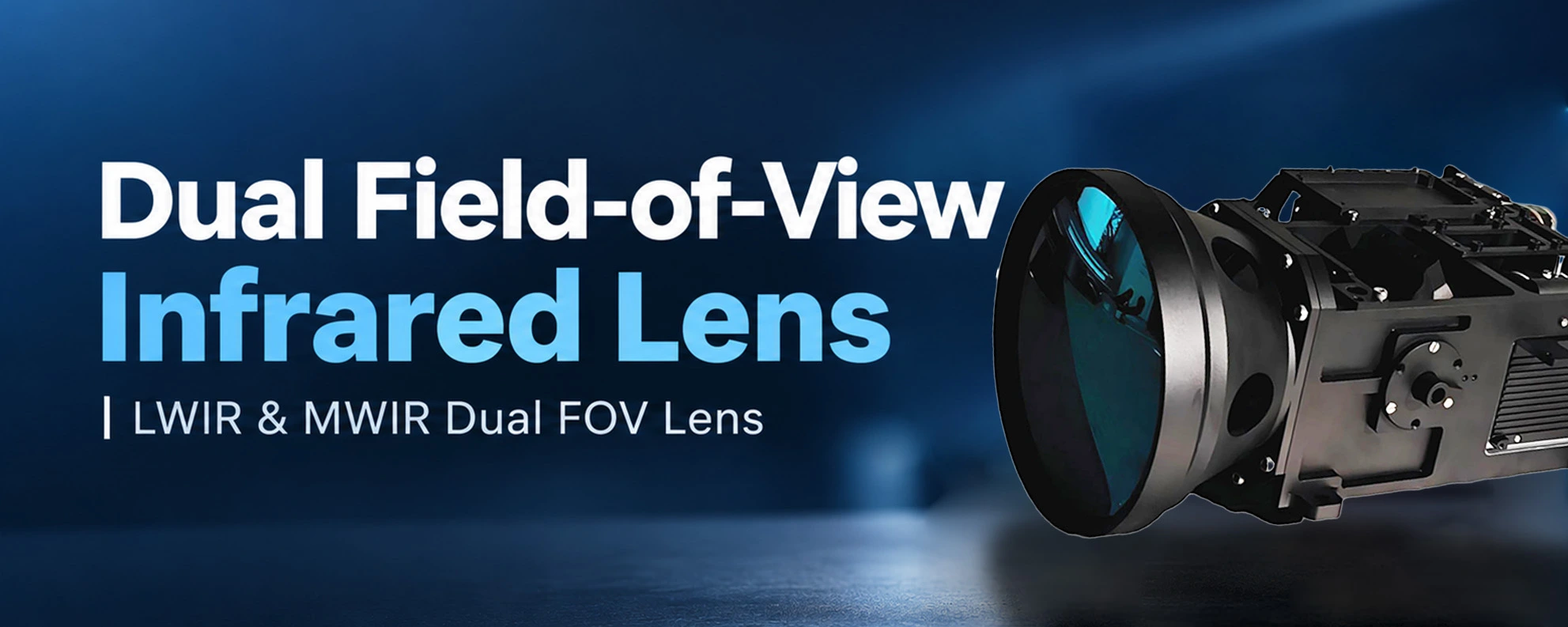
A dual field-of-view infrared lens is designed to provide two preset viewing modes: a wide field of view and a narrow field of view.
The wide field of view is useful for searching and scanning a larger area. The narrow field of view is useful for observing a target in more detail.
Dual FOV infrared lenses are commonly used in LWIR and MWIR thermal imaging systems for surveillance, long-range observation, maritime monitoring, border security, vehicle-mounted systems, and custom infrared lens modules.
What Is a Dual Field-of-View Infrared Lens?
A dual field-of-view infrared lens is an infrared lens that provides two different viewing modes in one lens system.
It usually has:
- Wide field of view
- Narrow field of view
The wide field of view helps the thermal camera scan a larger area.
The narrow field of view helps the thermal camera observe a smaller area or target in more detail.
In simple words, a dual FOV lens allows the system to switch between “search mode” and “observation mode” without changing the lens.
How Does a Dual Field-of-View Lens Work?
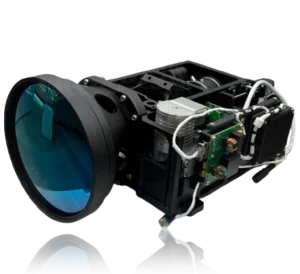
A dual field-of-view lens uses an optical and mechanical structure that allows the lens to switch between two preset focal length positions.
When the lens is in the wide FOV position, the camera can see a wider area.
When the lens is in the narrow FOV position, the camera can see a smaller area with more target detail.
Depending on the design, a dual FOV lens may include:
- Infrared lens group
- Lens housing
- Field-of-view switching mechanism
- Motorized focus mechanism, if required
- Lens control board
- Cable and connector interface
- Thermal core interface
The lens control board may be used to control field-of-view switching, focus movement, motor response, position feedback, and communication with the customer’s system.
Why Use a Dual Field-of-View Infrared Lens?
A dual field-of-view infrared lens is useful when the system needs both area search and target observation.
Main advantages include:
- Two viewing modes in one lens
- Wide FOV for area scanning
- Narrow FOV for target detail
- No need to manually change lenses
- Suitable for long-range observation
- Useful for surveillance and tracking systems
- Can support motorized switching
- Suitable for LWIR and MWIR thermal imaging systems
Compared with a fixed focus lens, a dual FOV lens provides more viewing flexibility.
Compared with a continuous zoom lens, a dual FOV lens is usually simpler because it only switches between two preset viewing modes instead of zooming smoothly across a full range.
Common Applications of Dual Field-of-View Infrared Lenses
Dual FOV infrared lenses are commonly used in applications where users need to search a wide area first, then observe a target more closely.
Common applications include:
- Security and surveillance systems
- Border monitoring
- Maritime monitoring
- Port and coastal surveillance
- Long-range thermal imaging
- Vehicle-mounted thermal cameras
- UAV and gimbal systems
- Search and rescue systems
- Fire monitoring systems
- Defense and aerospace systems
- Custom infrared camera modules
For example, a surveillance system may use the wide FOV mode to monitor a large area and switch to the narrow FOV mode when a target needs closer observation.
Dual FOV Lens for LWIR Systems
LWIR dual field-of-view lenses usually work in the 8–12 µm or 8–14 µm wavelength range.
They are commonly matched with uncooled thermal detectors.
Common detector formats include:
- 384 × 288 / 17 µm
- 640 × 512 / 12 µm
- 640 × 480 / 17 µm
- 1280 × 1024 / 12 µm
LWIR dual FOV lenses are commonly used in outdoor thermal imaging, security monitoring, vehicle-mounted systems, and long-range observation.
Dual FOV Lens for MWIR Systems
MWIR dual field-of-view lenses usually work in the 3–5 µm wavelength range.
They are commonly matched with cooled infrared detectors.
MWIR dual FOV lenses may be selected for applications that require higher sensitivity, longer observation distance, or more demanding image performance.
Common applications include:
- Long-range surveillance
- Maritime observation
- Aerospace imaging systems
- Defense-related infrared systems
- Tracking systems
- High-sensitivity thermal imaging
The correct MWIR dual FOV lens should be selected based on detector format, focal length, F-number, field of view, temperature range, and mechanical interface.
Dual FOV Lens vs Continuous Zoom Lens
Dual FOV lenses and continuous zoom lenses are both used when the system needs more than one viewing angle, but they work differently.
| Item | Dual FOV Lens | Continuous Zoom Lens |
|---|---|---|
| Viewing Mode | Two preset fields of view | Smooth zoom across a focal length range |
| Focal Length | Two fixed focal length positions | Continuously adjustable focal length |
| Operation | Switch between wide and narrow view | Zoom smoothly from wide to narrow |
| System Complexity | Usually simpler than continuous zoom | More complex zoom mechanism |
| Common Use | Search and target observation | Tracking, long-range observation, flexible zoom |
| Best For | Applications needing two clear viewing modes | Applications needing smooth zoom control |
A dual FOV lens is suitable when the system only needs two preset views.
A continuous zoom lens is more suitable when the system needs flexible zoom control across many focal length positions.
Dual FOV Lens vs Fixed Focus Lens
A fixed focus lens has one fixed focal length and one field of view.
A dual FOV lens has two field-of-view options.
| Lens Type | Simple Explanation | Common Use |
|---|---|---|
| Fixed Focus Lens | One fixed view | Compact thermal cameras, fixed monitoring |
| Dual FOV Lens | Two preset views: wide and narrow | Surveillance, search and observation |
| Continuous Zoom Lens | Smooth zoom range | Long-range tracking and flexible observation |
If the system only needs one viewing range, a fixed focus lens may be enough.
If the system needs both wide-area search and narrow-view observation, a dual FOV lens may be more suitable.
Main Specifications of a Dual Field-of-View Infrared Lens
When selecting a dual FOV infrared lens, customers should review the main specifications carefully.
| Specification | Example | What It Means |
|---|---|---|
| Wavelength Range | 8–12 µm / 3–5 µm | Shows whether the lens is LWIR or MWIR |
| Focal Length | 25 mm / 75 mm, or custom | Shows the two focal length positions |
| Field of View | Wide FOV / Narrow FOV | Shows the two viewing angles |
| F-number | F/1.0 / F/1.2 / F/2.0 | Indicates light-gathering ability |
| Detector | 640 × 512 / 12 µm | Shows suitable detector resolution and pixel size |
| Switching Method | Manual / motorized | Shows how the FOV changes |
| Focus Mode | Fixed / manual / motorized | Shows how focus is controlled |
| Lens Control Board | Based on design | Controls FOV switching and communication |
| Coating | AR / DLC / custom | Improves transmission or surface protection |
| Mount Type | Flange / thread / custom | Shows how the lens connects to the camera |
| Operating Temperature | Example: -40°C to +60°C | Important for outdoor and harsh environments |
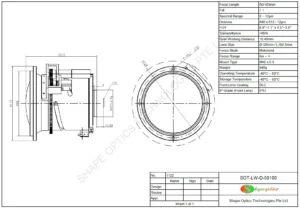
Example Dual FOV Infrared Lens (50/100mm | F1.1)
Thermal Core Matching and Interface Evaluation
For dual FOV lens projects, the thermal core information is important.
Customers may provide the thermal core specifications, such as:
- Detector type
- Detector resolution
- Pixel size
- Image format
- Sensor active area
- Required wide and narrow field of view
- Mechanical interface
- Back focal distance requirement
- 2D drawing
- 3D STP file
Based on this information, we can evaluate whether the selected thermal core is suitable to match with our dual field-of-view infrared lens or lens module.
If required, we can also review the optical matching, mechanical interface, mounting space, and integration requirement based on the customer’s thermal core specification.
What Information Should You Provide Before Requesting a Quote?
To request a dual field-of-view infrared lens, it is helpful to provide:
- Wavelength range: LWIR or MWIR
- Detector resolution
- Pixel size
- Required wide FOV and narrow FOV
- Required focal length, if known
- F-number requirement
- Focus mode requirement
- FOV switching requirement: manual or motorized
- Communication interface requirement
- Thermal core specification, if available
- 2D drawing or 3D STP file, if available
- Mechanical mounting interface
- Operating temperature
- Coating requirement
- Application, such as surveillance, maritime, vehicle-mounted, or long-range observation
- Quantity and project stage
Clear specifications help us evaluate the optical, mechanical, electrical, and system integration requirements more accurately.
Conclusion
A dual field-of-view infrared lens provides two preset viewing modes: wide FOV and narrow FOV.
It is useful for applications that require both wide-area search and closer target observation, such as security surveillance, border monitoring, maritime monitoring, long-range thermal imaging, vehicle-mounted systems, UAV platforms, and custom infrared camera modules.
The right dual FOV lens depends on wavelength range, detector resolution, pixel size, focal length, F-number, field of view, switching method, lens control board, coating, and mechanical interface.
Shape Optics provides LWIR and MWIR infrared lenses, including dual field-of-view lenses, continuous zoom lenses, fixed focus lenses, athermalized lenses, motorized focus lenses, lens control boards, and custom infrared lens module solutions.
Contact us to discuss your dual field-of-view infrared lens requirements.