
Developing a reliable infrared imaging system requires more than selecting a lens with the correct focal length. Optical performance, detector compatibility, environmental conditions, and mechanical integration all influence the final imaging results.
At Shape Optics, we support the development of Mid-Wave Infrared (MWIR) and Long-Wave Infrared (LWIR) lens solutions, from initial requirement analysis and optical design to precision manufacturing, performance verification, and production.
Whether the application involves thermal surveillance, industrial inspection, security systems, or unmanned aerial vehicles (UAVs), a structured development process helps ensure the optical solution meets the intended system requirements.
Step 1
Understand Your Imaging Requirements
Every infrared lens project begins with understanding the imaging application and its performance objectives.
The selection of an MWIR or LWIR lens depends on the operating wavelength, detector specifications, required field of view, and environmental conditions.
Key parameters to define:
- Operating wavelength: MWIR (3–5 µm) or LWIR (8–14 µm).
- Focal length: Determines the field of view and target magnification.
- F-number (F/#): Influences the optical aperture and energy reaching the detector.
- Detector specifications: Resolution, pixel pitch, and active image size.
- Environmental conditions: Operating temperature, humidity, vibration, and exposure requirements.
- Mechanical constraints: Available installation space, mounting interface, size, and weight.
By reviewing these requirements early, engineers can identify suitable optical configurations and reduce potential integration challenges.
Step 2
Select the Right Optical Architecture
Different infrared imaging applications require different lens configurations. Choosing the appropriate optical architecture is important for balancing imaging performance, functionality, and system complexity.
Common infrared lens solutions include:
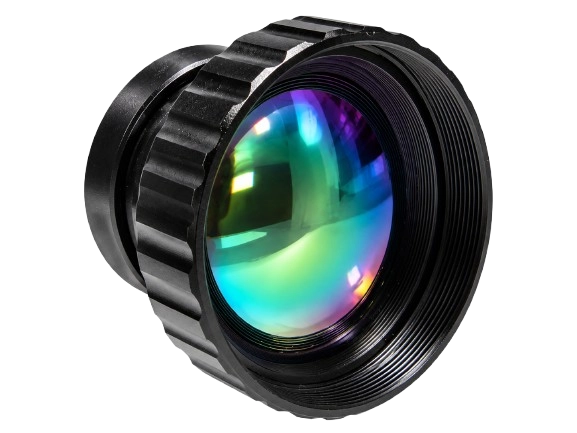
Athermalized Infrared Lenses
Athermalized designs compensate for temperature-related optical changes, helping maintain imaging performance over a specified operating temperature range.
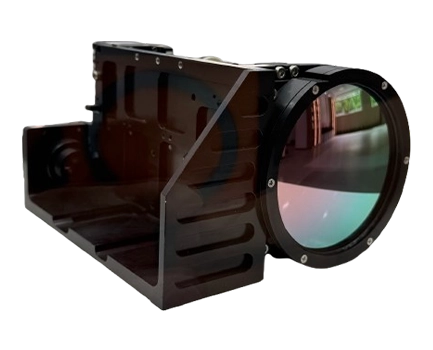
Dual Field of View (FOV) Lenses
Dual-FOV lenses provide two selectable focal lengths, supporting both wide-area monitoring and narrow-field observation.
Athermalized Infrared Lenses
Athermalized designs compensate for temperature-related optical changes, helping maintain imaging performance over a specified operating temperature range.
Dual Field of View (FOV) Lenses
Dual-FOV lenses provide two selectable focal lengths, supporting both wide-area monitoring and narrow-field observation.
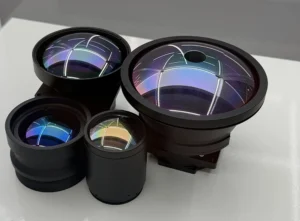
Custom Infrared Optical Designs
For applications with specialized optical, mechanical, or environmental requirements, custom lens development may be necessary.
Selecting the right architecture helps establish a practical foundation for the optical design process.
Step 3
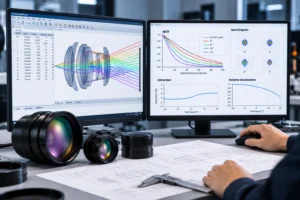
Optical Design & Simulation
Once the optical configuration is selected, detailed optical design and simulation are performed to evaluate and optimize system performance.
At Shape Optics, optical engineering includes the use of design and simulation software to assess how a lens performs under different operating conditions.
Important engineering considerations include:
- MTF performance: Evaluate resolution and image contrast.
- Distortion control: Minimize geometric image deformation.
- Thermal behavior: Analyze optical performance across the operating temperature range.
- Transmission efficiency: Optimize infrared energy transmission.
- DRI performance estimation: Estimate detection, recognition, and identification performance based on defined target and system assumptions.
- Mechanical compatibility: Ensure the optical design can be integrated into the required housing or imaging module.
These evaluations help refine the design before manufacturing begins.
Step 4
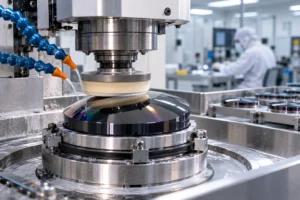
Precision Manufacturing
Infrared optical manufacturing requires specialized materials, tight dimensional tolerances, and appropriate surface finishing processes.
Shape Optics supports the fabrication and assembly of precision optical components for MWIR and LWIR imaging applications.
Core manufacturing capabilities include:
- Germanium optics: Widely used in infrared imaging applications.
- Chalcogenide glass optics: Alternative infrared-transmitting materials suited to selected optical designs.
- Optical coatings: Including antireflection (AR), diamond-like carbon (DLC), and other application-specific protective coatings.
- Precision optical assembly: Lens positioning, centering, and mechanical integration.
- Optical metrology: Measurement of optical surfaces, dimensions, and component quality.
Careful material selection and manufacturing control are essential for achieving the required optical specifications.
Step 5
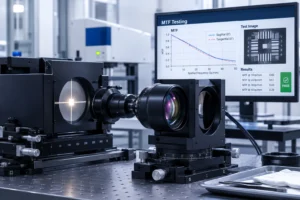
Testing & Qualification
After manufacturing and assembly, optical components and completed lens systems undergo inspection and performance verification according to the project requirements.
Typical verification activities include:
- MTF testing: Verify the imaging performance against the design specifications.
- Optical alignment: Check lens positioning and alignment accuracy.
- Thermal testing: Evaluate performance under specified temperature conditions.
- Environmental inspection: Check component condition and applicable environmental requirements.
- Mechanical verification: Confirm dimensions, mounting interfaces, and assembly integrity.
The exact testing and qualification procedures depend on the lens configuration, application, and agreed specifications.
Step 6
Production & Delivery
Following design validation and prototype evaluation, an infrared lens solution can progress toward the required production quantity.
Shape Optics supports different stages of product development, including:
- Prototype manufacturing and evaluation
- Small-batch production
- Volume manufacturing
- Final inspection and quality verification
- Relevant inspection and technical documentation
From initial development through production, coordination between optical design, manufacturing, and quality inspection helps ensure consistent product specifications.
MWIR & LWIR Lens Solutions for Different Applications
Shape Optics provides infrared optical solutions for a range of imaging systems, including:
- Security and surveillance: Long-range monitoring, perimeter protection, and observation systems.
- Industrial thermal imaging: Equipment inspection, process monitoring, and thermal analysis.
- UAV and airborne imaging: Infrared imaging systems requiring compact optical configurations.
- Thermal camera integration: Fixed focus, zoom, and specialized infrared imaging modules.
- Research and instrumentation: Custom infrared optical solutions for laboratory and technical applications.
Each application has different optical performance and integration requirements, making the selection of suitable infrared optics an important part of system development.
From Requirements to Production-Ready Infrared Optics
A well-structured engineering process connects imaging requirements, optical design, manufacturing, and performance verification.
With experience in infrared optical design, precision fabrication, thin-film coatings, and optical assembly, Shape Optics supports customers developing both standard and customized MWIR and LWIR lens solutions.
Looking for an infrared lens for your next project?
Explore our MWIR and LWIR lens solutions or contact the Shape Optics team to discuss your detector specifications, focal length requirements, environmental conditions, and customized optical design needs.