
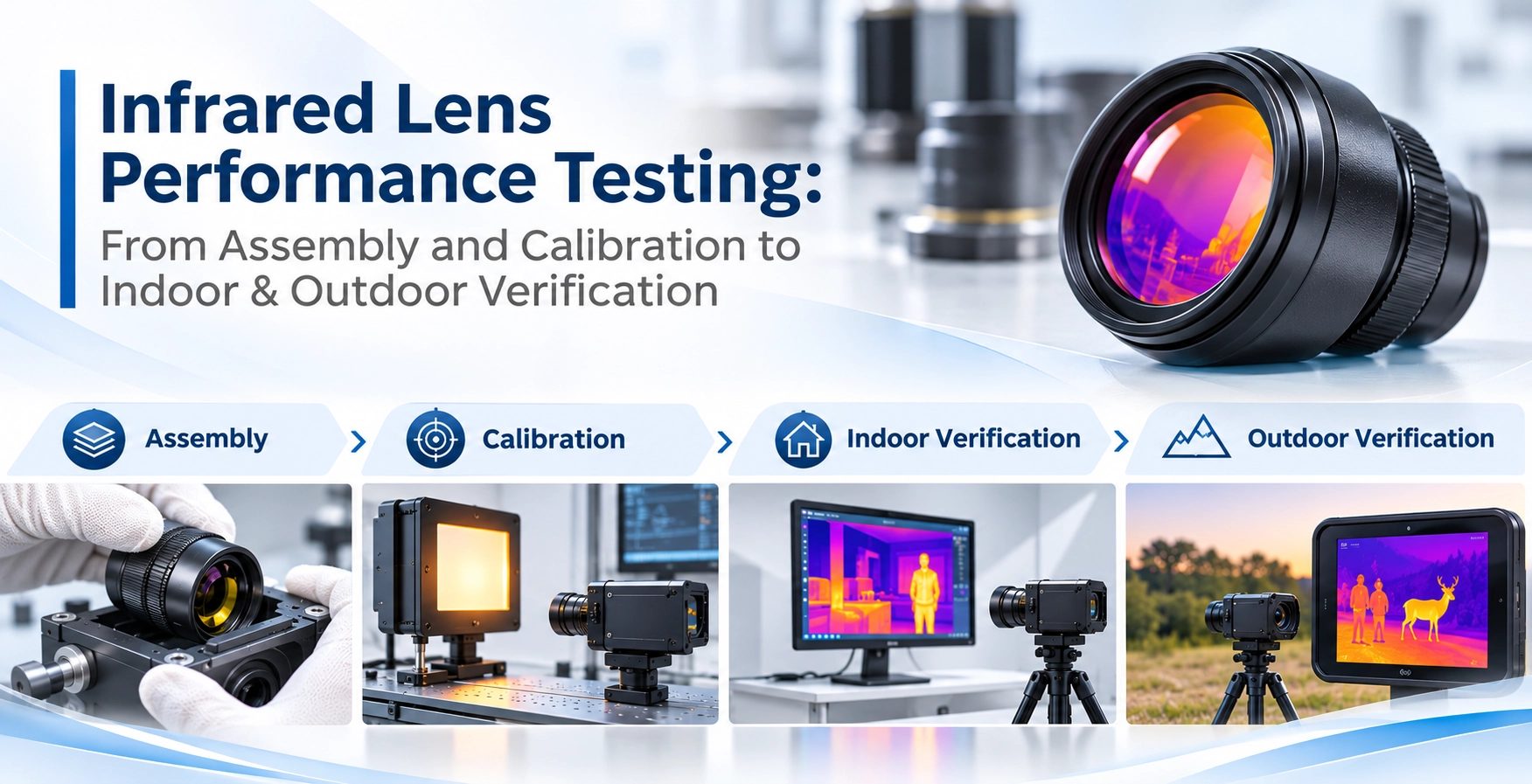
Description
Once engineers assemble the infrared optical elements, housing, mechanical parts, focus or zoom mechanisms, and related components, the lens still requires further evaluation before delivery.
The next stage involves calibration, optical alignment, functional testing, and performance verification.
Depending on the lens type, engineers may conduct collimator testing, MTF measurement, focus adjustment, field-of-view verification, motorized focus or zoom testing, indoor imaging tests, and outdoor performance testing.
Infrared Lens Performance Testing: What Happens After Assembly?
An infrared lens is more than a group of optical elements inside a mechanical housing.
Although assembly brings all the optical and mechanical components together, engineers still need to adjust and evaluate the completed lens to ensure that it performs according to the optical design.
Generally, the testing process follows several key stages:
Assembly → Calibration → Collimator Testing → Indoor Testing → Outdoor Testing → Final Inspection
However, the exact testing procedure varies depending on the lens type, including fixed focus, athermalized, motorized focus, continuous zoom, and dual field-of-view lenses.
STEP 1 — Complete Optical and Mechanical Assembly
The first stage involves assembling the optical and mechanical components.
Depending on the lens design, the assembly may include:
- Infrared optical elements
- Lens housing
- Spacers
- Retaining rings
- Mechanical mounts
- Focus mechanism
- Zoom mechanism
- Motors
- Gear or guide structures
- Cables and connectors
- Lens control board, where applicable
During assembly, engineers position the optical elements according to the design requirements.
Even small errors in element spacing, tilt, centering, or housing position can affect final image quality.
Therefore, evaluating individual optical components alone is insufficient to determine the overall optical performance.
Instead, engineers must test the complete lens assembly to verify its performance.
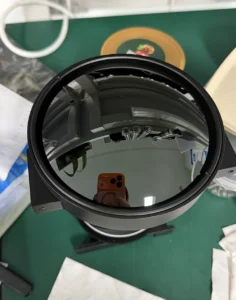
STEP 2 — Lens Calibration and Optical Alignment
Following assembly, engineers proceed with calibration and adjustment.
For an infrared lens assembly, calibration may include:
- Optical axis alignment
- Focus position adjustment
- Lens-to-image-plane adjustment
- Boresight alignment
- Mechanical position adjustment
- Motor zero-position setting
- Focus position calibration
- Zoom position calibration
- Wide / narrow FOV position calibration
- Position feedback verification
However, the exact calibration process depends on the lens type and its operating requirements.
Fixed Focus Lens
The focus position is adjusted and locked according to the specified working distance or infinity-focus requirement.
Athermalized Lens
The lens is adjusted to achieve the designed focus position before temperature-performance evaluation.
Motorized Focus Lens
Motor movement, focus range, limit positions, and focus repeatability may be checked.
Continuous Zoom Lens
Focus and zoom groups need to work together correctly throughout the focal-length range.
Calibration may include:
- Wide focal length position
- Intermediate focal length positions
- Long focal length position
- Focus tracking
- Zoom position
- Motor travel
- Position repeatability
Dual FOV Lens
Both wide and narrow field-of-view positions need to be adjusted and verified.
Note: Lens calibration in this context refers mainly to optical and mechanical alignment of the lens assembly. Detector radiometric or temperature calibration is part of the thermal imaging system and depends on the thermal core and final camera configuration.
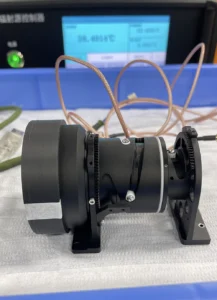
STEP 3 — Collimator Performance Testing
A collimator is an important tool for evaluating infrared lens performance.
Essentially, a collimator produces a controlled optical target that appears to the lens as though it were located at a very long distance or infinity.
As a result, engineers can evaluate infrared lens performance indoors without requiring a real target several hundred meters or kilometers away.
Depending on the test configuration, engineers may use collimator-based testing to evaluate:
- Focus position
- Image sharpness
- Effective focal length
- Back focal distance
- Field of view
- MTF performance
- On-axis performance
- Off-axis performance
- Distortion
- Resolution
- Image-plane position
However, the actual test items depend on the lens specifications and project requirements.
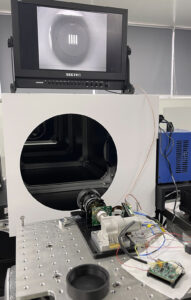
STEP 4 — MTF Performance Testing
MTF, or Modulation Transfer Function, describes how effectively an optical system transfers image detail and contrast.
For infrared lenses, engineers use MTF testing to evaluate image quality at different positions within the field of view.
Specifically, testing may include:
- Center field
- Mid-field
- Edge field
- Horizontal direction
- Vertical direction
- Different spatial frequencies
Furthermore, engineers may evaluate MTF performance at different focal lengths for continuous zoom lenses.
For example:
| Zoom Position | Possible Test |
|---|---|
| Wide | MTF / focus / FOV |
| Middle | MTF / focus tracking |
| Tele | MTF / focus / FOV |
By comparing these results, engineers can verify whether the assembled lens performs consistently throughout its operating range.
STEP 5 — Focus and Image-Plane Adjustment
Although individual optical elements may meet their specifications, the final assembled lens may still require fine focus adjustment.
Therefore, engineers perform focus testing to confirm that the image plane matches the detector position.
Typical checks may include:
- Infinity focus
- Near-focus distance
- Center sharpness
- Edge sharpness
- Focus repeatability
- Focus position across temperature
- Focus tracking during zoom
For customers who use an existing thermal core, the core specifications are particularly important. This is because the infrared lens must match the actual detector position and mechanical interface.
To support lens matching and integration evaluation, customers may provide:
- Thermal core datasheet
- Detector resolution
- Pixel pitch
- Sensor active area
- Back focal distance
- 2D drawing
- 3D STEP / STP file
Based on this information, engineers can evaluate the compatibility between the infrared lens and the thermal core.
STEP 6 — Field of View Verification
In addition to focus and MTF performance, field of view (FOV) is another important optical performance parameter.
During testing, engineers compare the measured field of view with the optical design specifications.
For example, evaluation may include:
- Horizontal FOV
- Vertical FOV
- Diagonal FOV
For continuous zoom lenses, engineers may check the field of view at different focal lengths.
Similarly, dual FOV lenses require verification of both wide and narrow field-of-view positions.
Several factors influence the field of view, including:
- Focal length
- Detector size
- Pixel pitch
- Optical design
- Lens-to-detector matching
Therefore, accurate detector information is essential when evaluating the field of view of an infrared lens.
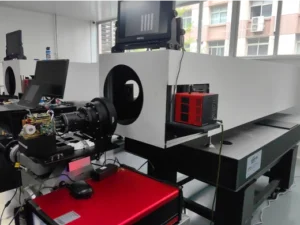
STEP 7 — Indoor Performance Testing
After completing basic calibration and optical measurements, engineers can evaluate the lens through indoor imaging tests.
Indoor testing provides a controlled environment where engineers can manage targets, distances, lighting conditions, and temperatures more consistently.
Depending on the project, indoor performance testing may include:
- Thermal target imaging
- Resolution target imaging
- Contrast evaluation
- Focus evaluation
- Center and edge image quality
- Wide / narrow FOV comparison
- Zoom performance
- Motorized focus testing
- Image stability
- Repeatability
In addition, engineers may use a suitable infrared target or blackbody source for thermal imaging evaluation where required.
These controlled conditions help engineers evaluate imaging performance and functional consistency.
STEP 8 — Motorized Function Testing
For motorized infrared lenses, optical performance represents only one part of the overall evaluation.
In addition, engineers must verify mechanical movement and electronic control functions.
Depending on the lens configuration, possible checks include:
Motorized Focus
- Focus movement
- Near / far limit
- Repeatability
- Position feedback
- Motor response
Continuous Zoom
- Zoom movement
- Wide-to-tele operation
- Intermediate positions
- Smoothness
- Focus tracking
- Position feedback
- Repeatability
Dual FOV
- Wide FOV switching
- Narrow FOV switching
- Switching time
- Position accuracy
- Repeatability
Furthermore, when the project includes a lens control board, engineers may also check communication and command response.
These functional checks help verify that the optical, mechanical, and electronic components work together correctly.
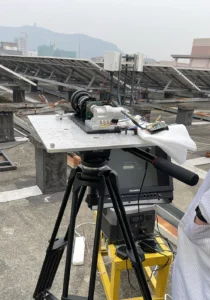
STEP 9 — Outdoor Performance Testing
While indoor testing provides controlled measurements, outdoor testing helps engineers evaluate infrared lens performance under more realistic operating conditions.
Depending on the focal length and application, outdoor testing may involve targets at different observation distances, such as:
- Short range
- Medium range
- Long range
- Very long range, depending on lens focal length
For example, engineers may observe:
- Buildings
- Vehicles
- People
- Trees
- Industrial structures
- High-contrast thermal targets
- Other suitable real-world targets
What Can Outdoor Testing Evaluate?
Outdoor performance testing can help engineers evaluate:
- Real-world image sharpness
- Long-distance detail
- Wide-area observation
- Target recognition
- Focus stability
- Zoom performance
- Edge image quality
- Contrast
- Image stability
- Practical field of view
For continuous zoom lenses, engineers can also observe the same target at different focal lengths.
As a result, outdoor testing helps demonstrate the practical differences between wide-area observation and detailed target imaging.
Wide FOV → Target Search
and
Narrow FOV / Long Focal Length → Target Detail
STEP 10 — Temperature Performance Testing
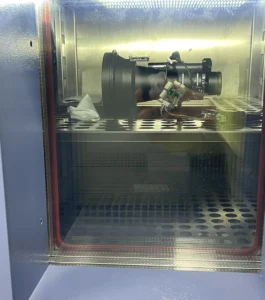
Infrared lens performance can change with temperature because temperature variations affect both optical materials and mechanical structures.
Therefore, for lenses that operate across wide temperature ranges, engineers may evaluate performance under several conditions:
- Low-temperature condition
- Room-temperature condition
- High-temperature condition
Typical performance checks may include:
- Focus shift
- MTF change
- Image quality
- Mechanical movement
- Zoom operation
- Focus operation
Temperature performance testing is particularly important for athermalized infrared lenses.
Unlike conventional lens designs that may require refocusing as temperatures change, an athermalized lens aims to maintain stable focus across its specified operating temperature range without frequent refocusing.
Consequently, temperature-performance evaluation helps verify whether the lens maintains its required optical performance under different operating conditions.
STEP 11 — Mechanical and Final Inspection
Once engineers verify optical and imaging performance, the lens assembly proceeds to final inspection.
Depending on the project requirements, final inspection may include:
- Lens appearance
- Housing condition
- Optical surface condition
- Coating condition
- Mechanical dimensions
- Mounting interface
- Cable and connector inspection
- Motor operation
- Lens control functions
- Labels and serial number
- Packing condition
Finally, after completing all required optical, mechanical, and functional checks, the team prepares the qualified lens assembly for final packing and delivery.
Typical Infrared Lens Performance Test Flow
Although the exact testing process varies by lens type and project requirements, the following table summarizes the typical evaluation stages.
| Stage | Main Purpose |
|---|---|
| Optical & Mechanical Assembly | Assemble all optical and mechanical components |
| Calibration | Adjust focus, alignment, zoom and mechanical positions |
| Collimator Testing | Evaluate far-field / infinity optical performance |
| MTF Testing | Evaluate contrast and image-detail performance |
| FOV Verification | Confirm required viewing angle |
| Indoor Testing | Controlled imaging and functional evaluation |
| Motorized Testing | Verify focus, zoom and FOV switching |
| Outdoor Testing | Evaluate real-world imaging performance |
| Temperature Testing | Evaluate performance across temperature |
| Final Inspection | Confirm optical, mechanical and cosmetic condition |
| Packing & Delivery | Prepare qualified lens for shipment |
Testing by Lens Type
Different infrared lens designs require different performance evaluation methods.
For example, fixed focus lenses primarily require focus and optical performance verification. In contrast, continuous zoom and dual FOV lenses also require additional mechanical and functional checks.
| Lens Type | Typical Evaluation |
|---|---|
| Fixed Focus Lens | Focus, FOV, MTF, image quality |
| Athermalized Lens | Focus, MTF, high/low temperature performance |
| Motorized Focus Lens | Focus range, motor movement, repeatability |
| Continuous Zoom Lens | Wide/mid/tele performance, zoom tracking, MTF, FOV |
| Dual FOV Lens | Wide/narrow FOV, switching accuracy, image performance |
| Custom Lens Module | Optical + mechanical + functional tests based on specification |
Ultimately, the lens design, application, operating environment, and customer specifications determine the appropriate testing requirements.
Conclusion
Infrared lens manufacturing does not end with the assembly of optical elements and mechanical components.
Instead, the complete lens assembly must undergo several additional stages before delivery:
Calibration → Alignment → Measurement → Testing → Verification
First, collimator testing provides a controlled method for evaluating far-field optical performance.
Next, indoor testing helps verify focus, resolution, FOV, zoom operation, and repeatability under controlled conditions.
Furthermore, outdoor testing provides an additional method for evaluating real-world imaging performance at practical observation distances.
For advanced infrared lenses, such as continuous zoom, dual FOV, motorized focus, and athermalized lenses, calibration and performance testing become even more important. This is because optical, mechanical, and control functions must work together as one integrated system.
Shape Optics provides LWIR and MWIR infrared lens solutions, including fixed focus, athermalized, motorized focus, continuous zoom, dual FOV, and custom infrared lens assemblies, with optical performance evaluation based on project requirements.
In addition, customers may provide their thermal core specifications, 2D drawings, and 3D STEP files for lens matching and integration evaluation.
Contact us to discuss your infrared lens requirements.