
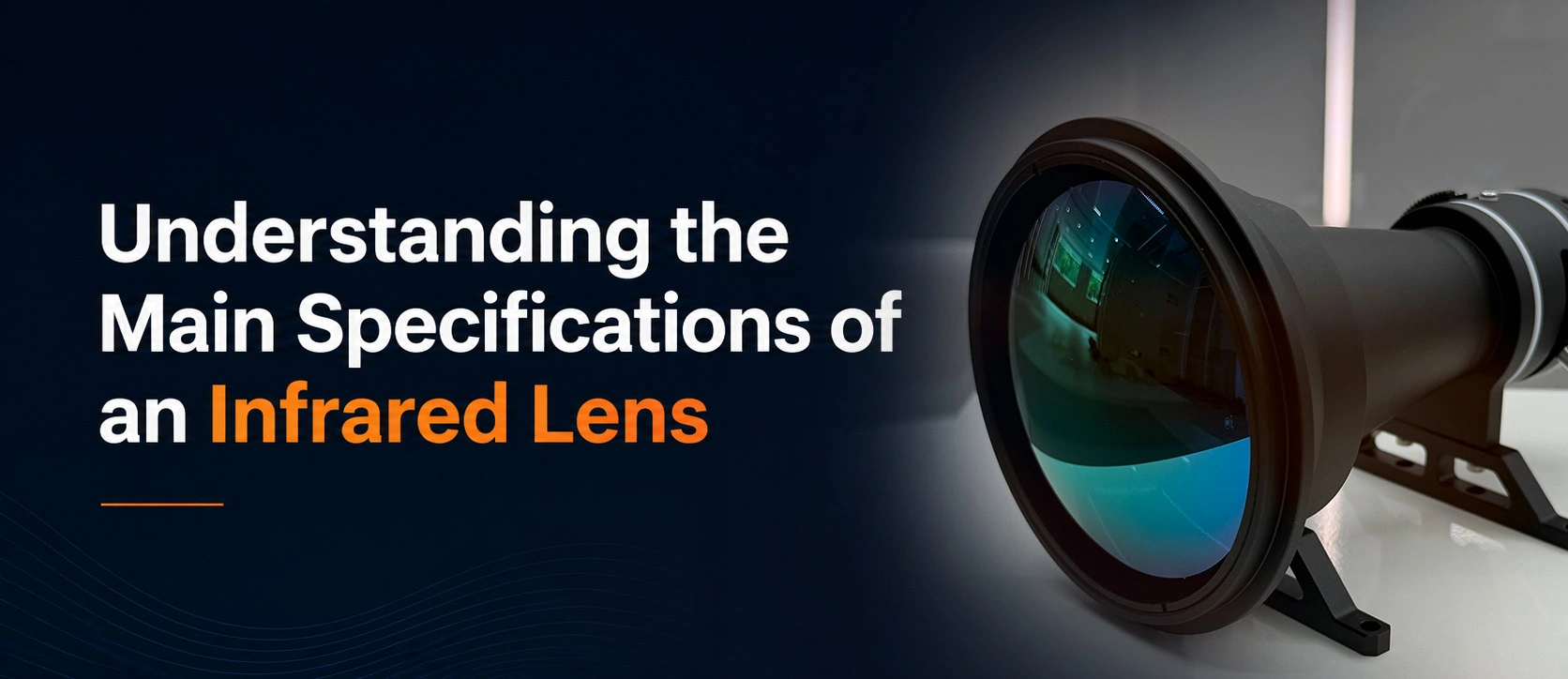
When selecting an infrared lens, it is important to understand the main specifications such as focal length, F-number, wavelength range, detector resolution, pixel size, field of view, transmittance, focus mode, coating, and mechanical interface.
These specifications help determine whether the lens is suitable for the thermal core, detector format, application distance, and working environment.
Understanding the Main Specifications of an Infrared Lens
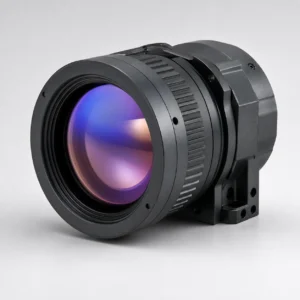
An infrared lens is an important optical component in a thermal imaging system.
It collects infrared energy from the target scene and focuses it onto the detector. To select the right infrared lens, customers need to understand several key specifications.
These specifications help determine the image field of view, brightness, detector matching, focusing performance, mechanical fit, and environmental suitability.
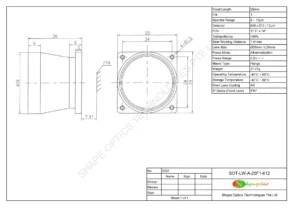
The drawing below is an example of a long-wave athermalized lens with focal length 25mm and F-number 1.
Focal Length
Focal length is one of the most important specifications of an infrared lens.
It is usually measured in millimeters, such as 9.1 mm, 25 mm, 50 mm, 100 mm, or 20–120 mm for zoom lenses.
In simple terms:
- Shorter focal length gives a wider field of view
- Longer focal length gives a narrower field of view and is suitable for longer-distance observation
For example, a 25 mm infrared lens is commonly used for medium field-of-view thermal imaging applications.
F-number / F#
F-number, also written as F/#, describes the light-gathering ability of the lens.
For infrared lenses, common examples include F/1.0, F/1.1, F/1.2, F/2.0, or other values depending on the design.
A lower F-number generally allows more infrared energy to reach the detector.
For example:
- F/1.0 lens allows more energy than F/1.4
- F/1.0 or F/1.1 is common for many LWIR uncooled thermal imaging systems
- Higher F-number may be used in some cooled or long focal length systems
The correct F-number depends on the detector, wavelength range, sensitivity requirement, and lens design.
Spectral Range / Wavelength Range
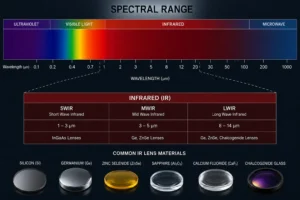
The spectral range tells us which infrared wavelength the lens is designed for.
Common infrared lens ranges include:
| Lens Type | Common Wavelength Range | Typical System |
|---|---|---|
| LWIR Lens | 8–12 µm or 8–14 µm | Uncooled thermal imaging systems |
| MWIR Lens | 3–5 µm | Cooled infrared systems |
| SWIR Lens | 0.9–1.7 µm or other SWIR range | SWIR imaging systems |
For example, an LWIR lens with a spectral range of 8–12 µm is designed for long-wave infrared thermal imaging systems.
The lens material and coating must be selected based on the required wavelength range.
Detector Resolution and Pixel Size
The infrared lens must match the detector used in the thermal core.
Detector information is usually written as:
- 640 × 512 / 12 µm
- 384 × 288 / 17 µm
- 1280 × 1024 / 12 µm
The first part is the detector resolution.
The second part is the pixel size.
For example:
640 × 512 / 12 µm means the detector has 640 pixels horizontally, 512 pixels vertically, and each pixel is 12 µm.
This information is important because it affects the field of view, image format, lens image circle, and optical matching.
Lens Resolution / Image Quality
When customers mention “resolution” for an infrared lens, it may refer to the detector resolution or the optical resolution of the lens.
Detector resolution means the sensor format, such as 640 × 512.
Lens optical resolution may be evaluated by image quality, MTF, or line pair performance, depending on the project requirement.
For most customer enquiries, it is helpful to provide both:
- Detector resolution and pixel size
- Required image quality or MTF requirement, if available
This helps the lens supplier evaluate whether the lens can support the required imaging performance.
Field of View / FOV
Field of view, or FOV, describes how much area the camera can see.
It is usually shown as horizontal FOV × vertical FOV.
For example:
17.5° × 14°
A wider FOV allows the system to see a larger area.
A narrower FOV allows the system to observe a smaller area in more detail.
FOV depends on:
- Focal length
- Detector size
- Pixel size
- Detector resolution
- Lens design
This is why detector information and focal length should be reviewed together.
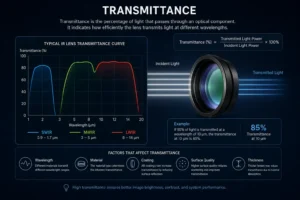
Transmittance
Transmittance tells us how much infrared energy can pass through the lens.
For example, a lens specification may state:
Transmittance >89%
Higher transmittance helps more infrared energy reach the detector, which can support better thermal image performance.
Transmittance can be affected by:
- Lens material
- Number of lens elements
- Coating design
- Wavelength range
- Surface quality
Rear Working Distance / Back Focal Distance
Rear working distance refers to the distance from the rear side of the lens to the detector or image plane.
This is important for mechanical integration with the thermal core or camera system.
If the rear working distance does not match the system design, the lens may not focus correctly on the detector.
For custom projects, customers may provide the thermal core specification, 2D drawing, or 3D STP file for evaluation.
Lens Size
Lens size usually refers to the outer diameter and total length of the lens.
For example:
Ø29 mm / L26 mm
This means the lens diameter is 29 mm and the lens length is 26 mm.
Lens size is important when the camera system has limited space or a compact housing design.
Focus Mode
Focus mode describes how the lens focus is adjusted.
Common focus modes include:
| Focus Mode | Simple Explanation |
|---|---|
| Fixed Focus | Focus is set at a fixed distance |
| Manual Focus | User adjusts focus manually |
| Motorized Focus | Focus is adjusted electronically |
| Athermalized | Lens maintains focus across temperature changes without frequent refocusing |
For outdoor thermal systems, an athermalized lens is commonly used because it helps maintain stable focus when the temperature changes.
Focus Range
Focus range tells us the distance range where the lens can focus.
For example:
2.5 m to infinity
This means the lens can focus from 2.5 meters to far-distance targets.
Focus range is important for applications such as surveillance, industrial inspection, vehicle-mounted thermal cameras, and long-range observation.
Mount Type
Mount type describes how the lens connects to the thermal core or camera housing.
Common examples include:
- Flange mount
- Thread mount
- Custom mechanical mount
The mount type must match the customer’s mechanical interface.
For customized projects, 2D drawings and 3D STP files are helpful for checking mechanical matching.
Weight
Lens weight is important for compact systems, handheld devices, drones, gimbals, and portable thermal cameras.
For example:
Weight: 27.27 g
A lighter lens can help reduce the overall system weight and improve integration flexibility.
Operating Temperature and Storage Temperature
Operating temperature tells us the temperature range where the lens can be used.
Storage temperature tells us the temperature range where the lens can be stored when not in operation.
For example:
| Item | Example |
|---|---|
| Operating Temperature | -40°C to +60°C |
| Storage Temperature | -40°C to +80°C |
These specifications are important for outdoor, industrial, automotive, surveillance, and harsh environment applications.
Front Lens Coating
The coating helps improve transmission or surface protection.
Common infrared lens coating options include:
- AR coating
- DLC coating
- HD coating
For example:
Front Lens Coating: AR
AR coating helps reduce reflection and improve infrared transmission.
For outdoor or exposed environments, DLC coating may be considered for better surface protection, depending on the lens design and application.
IP Grade
IP grade describes the protection level against dust and water.
For example:
IP67
This means the front lens or lens assembly has a certain level of dust and water protection, depending on the final design.
IP grade is useful for outdoor thermal cameras, surveillance systems, vehicle-mounted systems, and industrial environments.
Simple Specification Guide
| Specification | Example | What It Means |
|---|---|---|
| Focal Length | 25 mm | Affects field of view and observation distance |
| F-number | F/1.0 | Indicates light-gathering ability |
| Spectral Range | 8–12 µm | Shows the infrared wavelength range |
| Detector | 640 × 512 / 12 µm | Shows detector resolution and pixel size |
| FOV | 17.5° × 14° | Shows the viewing angle |
| Transmittance | >89% | Shows how much IR energy passes through |
| Rear Working Distance | 7.41 mm | Helps match the detector position |
| Lens Size | Ø29 mm / L26 mm | Shows the physical size of the lens |
| Focus Mode | Athermalization | Helps maintain focus across temperature changes |
| Focus Range | 2.5 m to infinity | Shows usable focusing distance |
| Mount Type | Flange | Shows mechanical mounting method |
| Weight | 27.27 g | Important for compact systems |
| Operating Temperature | -40°C to +60°C | Shows working temperature range |
| Storage Temperature | -40°C to +80°C | Shows storage condition |
| Front Lens Coating | AR | Helps improve infrared transmission |
| IP Grade | IP67 | Shows dust and water protection level |
Example Infrared Lens Specification
| Item | Example Specification |
| Lens Type | LWIR athermalized lens |
| Focal Length | 25 mm |
| F-number | F/1.0 |
| Spectral Range | 8–12 µm |
| Detector Matching | 640 × 512 / 12 µm |
| Field of View | 17.5° × 14° |
| Transmittance | >89% |
| Rear Working Distance | 7.41 mm |
| Lens Size | Ø29 mm / L26 mm |
| Focus Mode | Athermalized |
| Focus Range | 2.5 m to infinity |
| Mount Type | Flange |
| Weight | 27.27 g |
| Operating Temperature | -40°C to +60°C |
| Storage Temperature | -40°C to +80°C |
| Front Lens Coating | AR coating |
| IP Grade | IP67 at front lens |
What Information Should Customers Provide Before Requesting a Quote?
To recommend a suitable infrared lens, it is helpful to provide:
- Wavelength range: LWIR or MWIR
- Detector resolution
- Pixel size
- Required focal length
- Required field of view
- F-number requirement
- Focus mode: fixed focus, manual focus, motorized focus, or athermalized
- Focus range or working distance
- Rear working distance or back focal distance requirement
- Mounting interface
- Lens size limitation
- Operating temperature
- Coating requirement
- IP grade requirement, if any
- Application, such as surveillance, thermal imaging, industrial inspection, or long-range observation
- 2D drawing or 3D STP file, if available
Conclusion
Understanding infrared lens specifications helps customers select the right lens for their thermal imaging system.
Important specifications include focal length, F-number, spectral range, detector resolution, pixel size, field of view, transmittance, rear working distance, focus mode, coating, mount type, and operating temperature.
Shape Optics provides LWIR and MWIR infrared lenses, including fixed focus lenses, athermalized lenses, motorized focus lenses, continuous zoom lenses, dual field-of-view lenses, and custom infrared lens modules.
Contact us to discuss your infrared lens specification requirements.