
Description
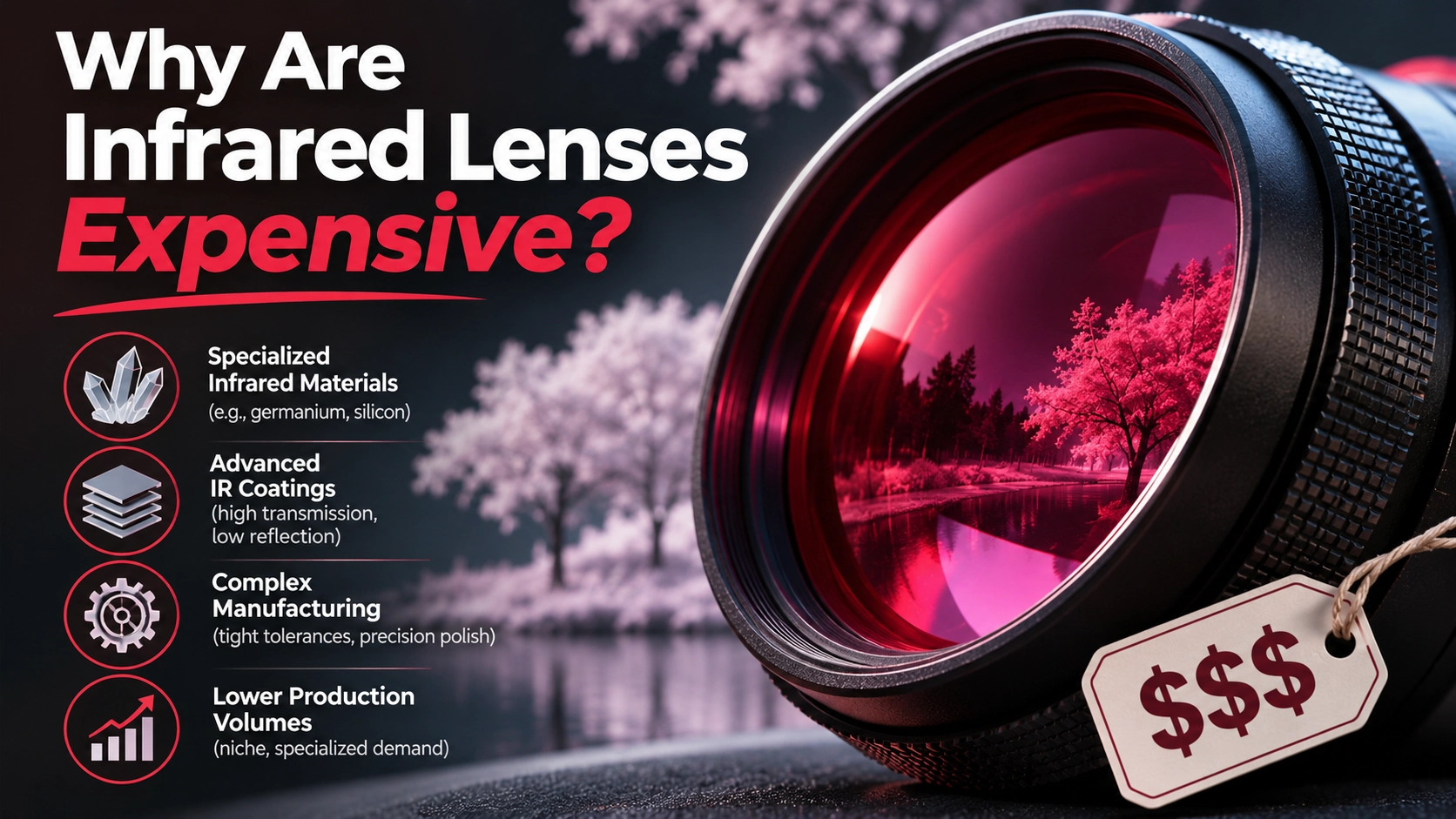
Infrared lenses are usually more expensive than conventional visible-light lenses because they require special infrared materials, precision optical design, advanced manufacturing, infrared coatings, thermal compensation, and demanding inspection.
The final cost depends on factors such as wavelength range, lens material, focal length, F-number, detector resolution, lens diameter, optical performance, coating, environmental requirements, and whether the lens is fixed focus or continuous zoom.
Why Are Infrared Lenses Expensive?
When selecting a thermal camera, customers often focus first on the detector:
- Resolution
- Pixel pitch
- NETD
- Frame rate
- Measurement capability
But the detector is only part of the infrared imaging system.
Another critical component is the infrared lens.
Infrared lenses are usually much more expensive than ordinary visible-light lenses because they cannot simply use the same glass, manufacturing processes, and coating technologies found in conventional cameras.
A high-performance IR lens must do more than simply transmit infrared energy.
It needs to provide:
- High infrared transmission
- Good image quality
- Low aberration
- Suitable F-number
- Stable focus
- Reliable environmental performance
- Accurate detector matching
- Consistent manufacturing quality
Understanding these factors helps explain why infrared lenses can represent a significant part of the cost of a thermal imaging system.
Infrared Lenses Require Special Optical Materials
One of the biggest differences between visible and infrared lenses is the optical material.
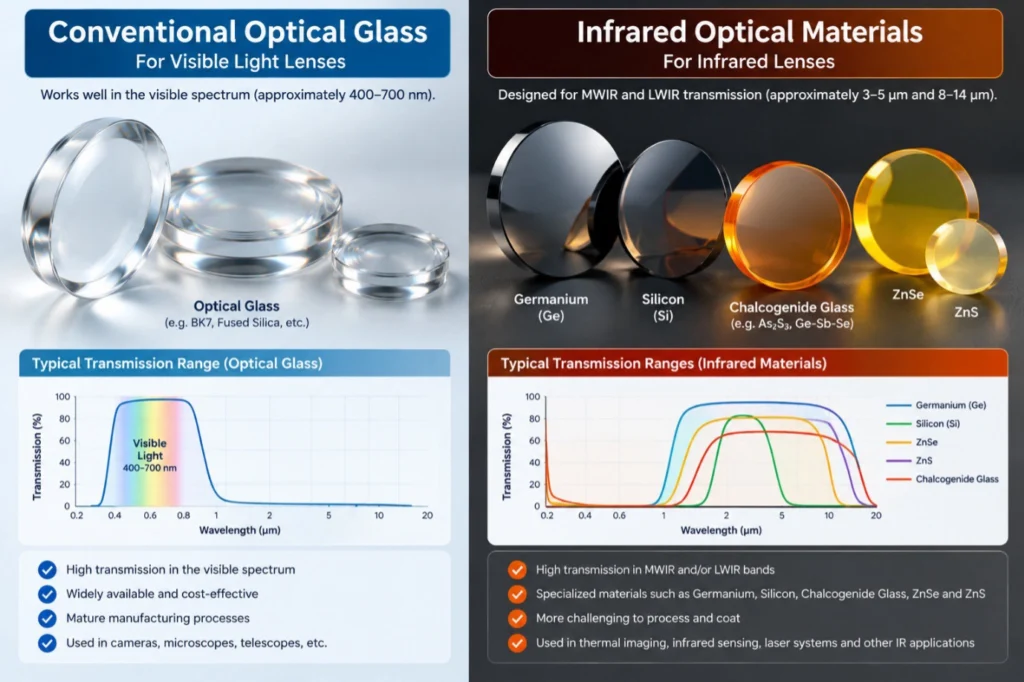
Visible-light systems commonly operate around the visible spectrum and can use a wide range of conventional optical glasses.
Thermal imaging systems operate at much longer wavelengths.
Common infrared imaging bands include: MWIR (approximately 3-5 µm) and LWIR (approximately 8-12 µm or 8–14 µm).
Many conventional optical glasses do not transmit efficiently in these wavelength ranges.
Infrared lenses therefore require special materials such as:
- Germanium
- Silicon
- Chalcogenide Glass / IRG
- ZnSe
- ZnS
- Other infrared optical materials
These materials are generally more specialized and may require different manufacturing, coating, and inspection processes.
Germanium Can Be a Major Cost Factor
Germanium is one of the most widely recognized materials in infrared optics.
It is commonly used for infrared lenses and windows because of its useful transmission properties and high refractive index.
A high refractive index gives optical designers strong control over light within a relatively compact optical structure.
However, Germanium also brings several cost considerations.
Material Cost
Optical-grade Germanium is a specialized material and usually costs considerably more than conventional optical glass.
Larger lens diameters and thicker elements require more raw material.
Weight
Germanium is relatively dense.
For large-aperture or long-focal-length lenses, this can increase:
- Lens weight
- Mechanical support requirements
- Housing requirements
- Assembly complexity
Processing
Germanium lenses may require:
- Cutting
- Grinding
- Polishing
- Single-point diamond turning
- Edge processing
- Coating
- Precision inspection
Because the raw material itself is valuable, manufacturing loss or rejected parts can also be costly.
Chalcogenide Glass Provides Another IR Material Option
Chalcogenide Glass has become an important material option for infrared optics.
Depending on the grade, it can support MWIR or LWIR applications and may be used for:
- Infrared lenses
- Aspherical elements
- Molded IR optics
- Thermal imaging lenses
- Compact optical systems
One important advantage is that suitable Chalcogenide Glass materials can sometimes be precision molded.
For volume production, this can offer an alternative manufacturing route to traditional grinding and polishing.
Chalcogenide Glass may therefore be considered as an alternative to Germanium in selected lens designs.
However, it is not automatically a direct replacement.
The optical designer must still consider:
- Wavelength range
- Refractive index
- Dispersion
- Thermal characteristics
- Mechanical properties
- Coating compatibility
- Environmental requirements
- Manufacturing volume
In many infrared lenses, the best solution may involve a combination of different materials.
Infrared Lens Material Selection Is a Trade-Off
No single material is best for every infrared application.
| Material | Typical Optical Use | Design Consideration |
|---|---|---|
| Germanium | IR lenses and windows | Strong IR performance, but relatively high material cost and weight |
| Silicon | IR lenses and windows | Good mechanical properties for suitable wavelength ranges |
| Chalcogenide Glass | IR lenses and molded optics | Useful for compact and molded infrared lens designs |
| ZnSe | IR lenses, windows and laser optics | Broad IR use, including laser applications |
| ZnS | Windows, lenses and protective optics | Useful where IR transmission and durability are required |
Material selection is therefore a balance between:
Transmission + refractive index + thermal behavior + mechanical performance + manufacturing + cost.
Small F/# Infrared Lenses Cost More
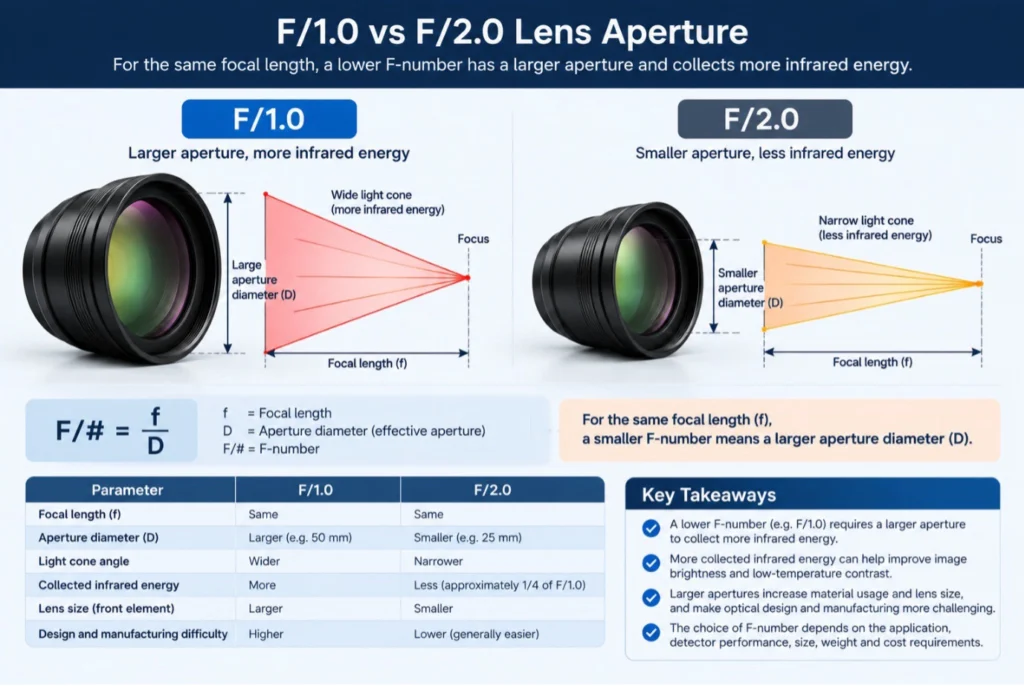
F-number, written as F/#, is another major factor affecting infrared lens cost.
In simple terms:
Lower F/# = larger aperture = more infrared energy reaching the detector.
For example:
- F/1.0
- F/1.2
- F/1.4
- F/2.0
For the same focal length, an F/1.0 lens generally requires a larger effective aperture than an F/2.0 lens.
This can improve the amount of infrared energy collected by the system.
However, a smaller F/# also makes the lens more difficult to design and manufacture.
Why?
Larger Optical Elements
A larger aperture generally means larger infrared lens elements.
More material means higher material cost.
Harder Aberration Correction
Fast optical systems are more sensitive to:
- Spherical aberration
- Coma
- Astigmatism
- Field curvature
- Distortion
The optical design may therefore require more complex surfaces or additional corrective elements.
Tighter Assembly Tolerances
Fast lenses can also be more sensitive to:
- Decenter
- Tilt
- Lens spacing
- Detector position
This increases manufacturing and assembly requirements.
Aspherical Surfaces Increase Performance — and Manufacturing Complexity
Aspherical lens surfaces are very important in modern infrared optics.
Compared with a simple spherical surface, an aspherical surface provides greater design freedom.
It can help:
- Reduce spherical aberration
- Improve image quality
- Improve edge performance
- Reduce the number of lens elements
- Reduce overall lens length
- Support compact optical systems
This is especially valuable in infrared optics because every additional lens element can increase:
- Material cost
- Coating cost
- Weight
- Assembly complexity
- Transmission loss
However, aspherical elements are harder to manufacture.
Processes may include:
- Single-point diamond turning
- Precision molding
- CNC optical machining
- Precision polishing
- Surface-profile measurement
So although an aspherical surface may reduce the number of elements, the individual component itself may require more advanced manufacturing.
Infrared Coatings Add Significant Value
An infrared material transmitting the required wavelength does not automatically mean the finished lens will have high transmission.
Many IR materials have relatively high refractive indices, which can result in significant surface reflection.
A lens with multiple optical surfaces can therefore lose a noticeable amount of energy without suitable coating.
Common infrared coatings include:
- AR coating
- BBAR coating
- DLC coating
AR Coating
Anti-reflection coating helps reduce surface reflection and improve infrared transmission.
Common coating bands may include:
- MWIR 3–5 µm
- LWIR 8–12 µm
- LWIR 8–14 µm
- Custom infrared bands
DLC Coating
DLC, or Diamond-Like Carbon coating, may be applied to selected exposed IR surfaces where additional environmental protection is needed.
It can be useful for:
- Outdoor systems
- Surveillance cameras
- Vehicle-mounted equipment
- Harsh environments
- Front optical elements
Infrared Coating Is More Than Just “Adding a Film”
Infrared coating has its own engineering challenges.
The coating must work together with:
- Substrate material
- Wavelength range
- Surface shape
- Temperature range
- Environmental requirements
For broadband infrared systems, the coating may need to maintain high transmission across a relatively wide wavelength range.
For outdoor systems, it may also need to withstand:
- Humidity
- Temperature cycling
- Cleaning
- Dust
- Environmental exposure
The coating process therefore contributes both to performance and overall lens cost.
Athermalization Adds Another Layer of Design Complexity
One of the most important challenges in infrared optics is temperature change.
An infrared lens may operate in environments ranging from cold outdoor conditions to hot industrial or vehicle environments.
Temperature changes affect both:
- Optical materials
- Mechanical housing
As temperature changes, the refractive index of the lens material can change.
At the same time, the lens housing and spacing between elements may expand or contract.
The result can be focus shift.
An image that is sharp at room temperature may become less sharp at another temperature.
This is why many infrared lenses require athermalization.
Athermalization Methods
Athermalization may involve:
Optical Athermalization
Different infrared materials are selected so their thermal behavior helps compensate for each other.
Mechanical Athermalization
The thermal expansion of the mechanical structure is designed to compensate for optical focus shift.
Active Focus Control
A motorized focus system can adjust the lens position as operating conditions change.
High-performance systems may use one or more of these approaches.
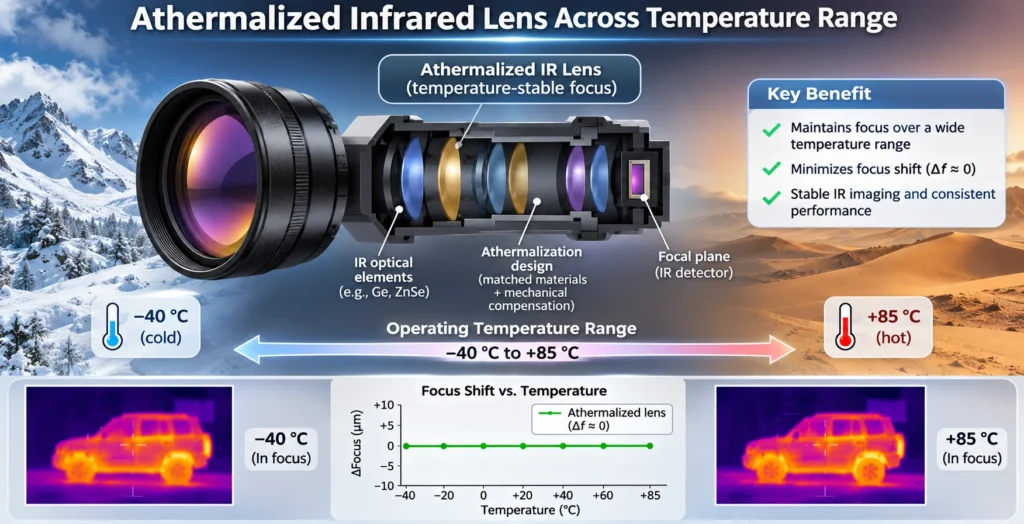
Athermalized lens design helps maintain more stable focus as operating temperature changes.
Long-Focal-Length Infrared Lenses Are More Expensive
Long-range thermal imaging usually requires longer focal lengths.
Examples include:
- Perimeter surveillance
- Border monitoring
- Maritime observation
- Forest fire monitoring
- UAV surveillance
- Long-distance industrial monitoring
Long-focal-length infrared lenses can cost more because they often require:
- Larger optical elements
- More IR material
- More complex aberration correction
- Tighter alignment
- More rigid mechanical structures
- More demanding MTF testing
As focal length and aperture increase, the complete optical-mechanical system becomes more demanding.
Continuous Zoom Infrared Lenses Are Even More Complex
A fixed focal length lens only needs to perform at one focal length.
A continuous zoom lens must maintain good performance across an entire focal length range.
For example:
20–120 mm or 50–500 mm
A continuous zoom lens may require several moving optical groups.
The system needs to control:
- Zoom position
- Focus position
- Image plane stability
- Optical performance across focal lengths
- Mechanical movement
- Lens control
- Boresight stability
- Temperature performance
A zoom lens module may therefore include:
- Multiple optical groups
- Motors
- Mechanical guide structures
- Position feedback
- Lens control board
- Cable interface
This is why a continuous zoom infrared lens generally costs significantly more than a simple fixed focus lens.
High-Resolution Detectors Require Better Lenses
Detector technology also affects lens cost.
A higher-resolution detector or smaller pixel pitch places greater demands on optical performance.
For example:
- 640 × 512 @ 17 µm
- 640 × 512 @ 12 µm
- 1280 × 1024 @ 12 µm
- 1280 × 1024 @ 8 µm
As pixel pitch becomes smaller, the lens generally needs to deliver higher spatial resolution to make full use of the detector.
This can increase requirements for:
- MTF
- Surface figure
- Alignment
- Centering
- Focus
- Manufacturing tolerance
A high-resolution detector therefore benefits from an optical system designed to match it.
Precision Manufacturing and Assembly Add Cost
A finished infrared lens is not simply a collection of optical elements.
The elements must be manufactured and assembled accurately.
Typical processes may include:
- Raw material inspection
- Cutting
- Grinding
- Polishing
- Diamond turning
- Coating
- Centering
- Housing machining
- Optical assembly
- Alignment
- Focus adjustment
- Final inspection
Small errors in:
- Lens spacing
- Tilt
- Decenter
- Detector position
- Housing dimensions
can affect final image quality.
This is especially important for fast lenses, long-focal-length lenses and zoom lenses.
Testing an Infrared Lens Is Also Specialized
Infrared lenses need to be evaluated using appropriate IR testing equipment.
Depending on the project, testing may include:
- Visual inspection
- Dimensional inspection
- Transmission measurement
- MTF testing
- Focal length verification
- Field-of-view verification
- Distortion evaluation
- Focus testing
- Thermal testing
- Environmental testing
- Motorized function testing
For custom or high-performance lenses, testing requirements can add significant engineering and production effort.
Why Does the Lens Matter to Thermal Imaging Performance?
A high-performance detector cannot compensate for every limitation of the optical system.
The infrared lens determines how much useful infrared energy reaches the detector and how accurately the scene is imaged onto it.
Lens performance can affect:
- Image sharpness
- Contrast
- Signal level
- Edge image quality
- Long-range detail
- Small-target detection
- Focus stability
For measurement systems, lens transmission and focus stability can also be important parts of overall system calibration.
A thermal camera should therefore be considered as a complete optical-imaging system rather than just a detector.
What Makes an Infrared Lens Expensive?
The main cost factors can be summarized as follows:
| Cost Factor | Why It Matters |
|---|---|
| IR Materials | Germanium, Silicon, ZnSe and Chalcogenide are more specialized than conventional glass |
| Large Aperture | Lower F/# requires larger elements and more material |
| Aspherical Surfaces | Improve performance but require advanced manufacturing |
| IR Coatings | Needed for transmission and environmental protection |
| Athermalization | Helps maintain focus across temperature changes |
| Long Focal Length | Requires larger optics and tighter alignment |
| Continuous Zoom | Adds moving optical groups, motors and control systems |
| High Detector Resolution | Requires higher optical resolution and tighter tolerances |
| Precision Assembly | Small alignment errors can affect image quality |
| Testing | MTF, thermal and environmental verification require specialized equipment |
Example: Simple Lens vs High-Performance Lens
| Feature | Basic Fixed Lens | High-Performance IR Lens |
|---|---|---|
| Focal Length | Fixed | Fixed / Long / Zoom |
| F/# | Moderate | Fast F/# such as F/1.0 |
| Optical Surfaces | Mainly spherical | Spherical + aspherical |
| Temperature Compensation | Basic | Athermalized |
| Coating | Standard AR | Broadband AR / DLC / custom |
| Detector | Standard pixel pitch | High-resolution / small pixel pitch |
| Mechanical System | Simple | Precision or motorized |
| Testing | Basic inspection | MTF + environmental + functional verification |
How Can Customers Control Infrared Lens Cost?
Not every project requires the most complex lens.
A more cost-effective design may be possible by clearly defining the actual system requirements.
Customers should consider:
- Required detection distance
- Required field of view
- Detector resolution
- Pixel pitch
- F-number
- Operating temperature
- Fixed focus vs motorized focus
- Fixed lens vs continuous zoom
- Environmental requirements
- Quantity
Avoiding unnecessarily tight specifications can help reduce design and manufacturing cost.
For example, specifying an F/1.0 lens when F/1.4 is sufficient may significantly increase the optical difficulty and lens size.
Similarly, a fixed focus lens may be more suitable than a continuous zoom lens if the application does not require variable focal length.
Conclusion
Infrared lenses are expensive because they are not simply conventional lenses made from a different material.
Every stage is more specialized:
Special IR materials
→ Germanium, Silicon, Chalcogenide and other materials are required.
Fast F/#
→ Larger apertures and more difficult aberration correction.
Aspherical optics
→ Better performance but more demanding manufacturing.
Infrared coatings
→ Required to improve transmission and protect exposed surfaces.
Temperature changes
→ Require athermalized optical and mechanical design.
Long focal lengths and zoom systems
→ Increase optical, mechanical and control complexity.
High-resolution detectors
→ Require higher lens performance and tighter tolerances.
A high-performance infrared lens must do more than simply focus infrared energy onto a detector.
It needs to deliver:
High transmission, good resolution, stable focus, low aberration, reliable environmental performance and consistent image quality.
The detector determines how infrared energy is sensed.
The lens determines how much high-quality infrared information reaches the detector.
That is why the infrared lens plays such an important role in the overall performance — and cost — of a thermal imaging system.
Shape Optics provides MWIR and LWIR infrared lens solutions including fixed focus, athermalized, motorized focus, continuous zoom, dual FOV and custom infrared lens designs.
Contact us to discuss your infrared lens requirements.