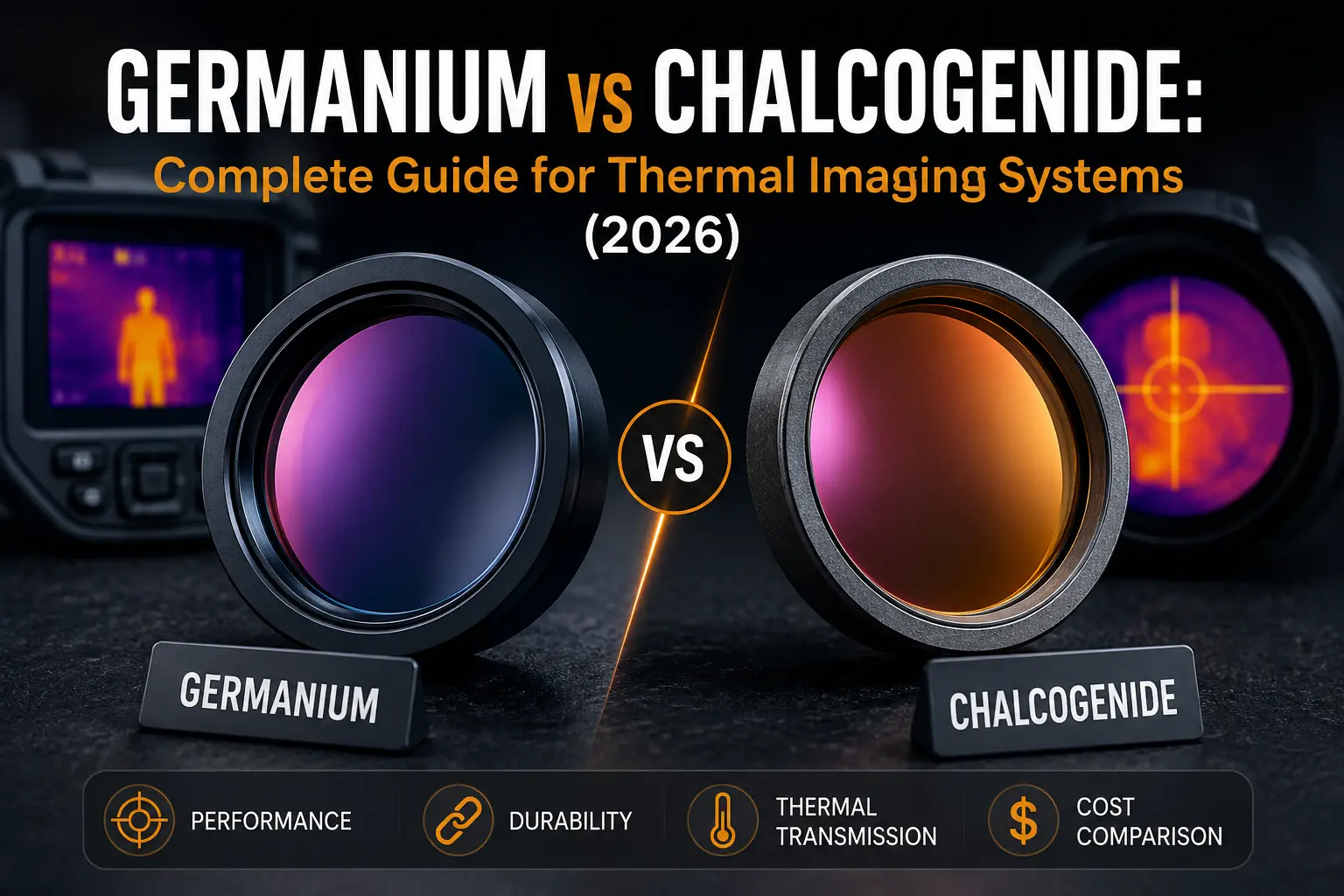
When comparing Germanium vs Chalcogenide materials for thermal imaging systems, engineers must carefully evaluate optical performance, thermal stability, durability, weight, and cost. Both materials are widely used in LWIR (8–12 μm) and MWIR (3–5 μm) optics. However, each material offers distinct advantages depending on the application. Therefore, selecting the right material can significantly affect imaging performance, system reliability, and overall project cost. In this guide, we compare Germanium and Chalcogenide lenses to help you identify the optimal solution for your infrared imaging system.
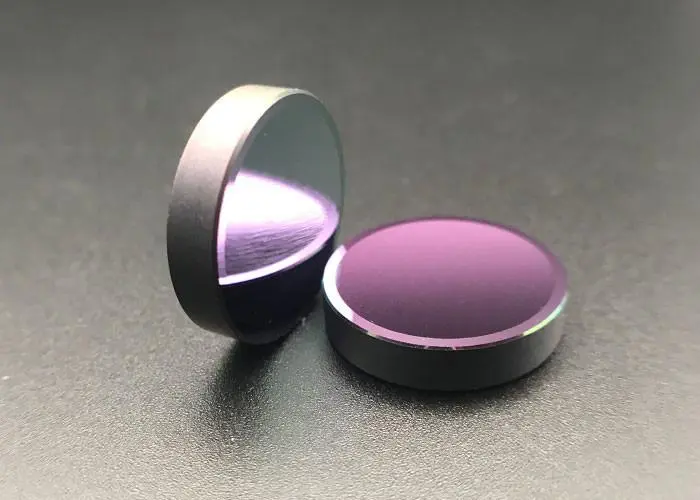
Germanium Lenses: Pros and Considerations
Germanium has traditionally been the preferred material for long-wave infrared optics due to its exceptional IR transmission and thermal stability. Furthermore, engineers often choose Germanium for demanding thermal imaging applications that require high optical performance and long-term stability.
Key Advantages:
- High Transmission: Uncoated Ge transmits ~50–55%, while AR coatings can boost LWIR transmittance above 90%.
- Thermal Stability: Its refractive index changes minimally with temperature, which makes it ideal for athermalized designs.
- Mechanical Strength: Germanium is durable under standard operating conditions and withstands high-precision polishing.
- Low Dispersion: It provides excellent image quality and reduces chromatic aberration.
Considerations:
- Cost: Germanium is expensive and has limited global availability.
- Weight: Its higher density can impact compact lens design.
- Fragility under Shock: Germanium can be brittle under extreme mechanical stress.
- IR Band Limitations: Primarily effective in 7–12 µm; anti-reflective coatings are required for optimal performance.
Applications: Germanium lenses are ideal for LWIR security cameras, high-end industrial inspection, and long-range thermal imaging systems where clarity and stability are crucial.
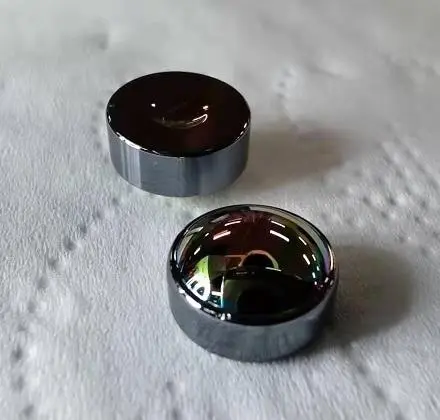
Chalcogenide (IRG) Lenses: Pros and Considerations
Chalcogenide glass (IRG series) provides a flexible and cost-effective alternative to Germanium for many thermal imaging applications. In addition, its lower density allows engineers to design lighter optical systems without significantly sacrificing infrared performance.
Key Advantages:
- Broad IR Transmission: Supports MWIR and LWIR; transparent across 3–12 µm depending on composition.
- Lightweight: Its lower density allows for more compact lens systems.
- Customizable Properties: IRG can be tailored for hardness, thermal expansion, and transmission.
- Cost-Effective: It is less expensive than Germanium, making it suitable for mid-volume production.
Considerations:
- Thermal Sensitivity: IRG’s refractive index is more sensitive to temperature changes, so athermalization may be necessary.
- Durability: Softer than Germanium, which means protective coatings or treatments are recommended.
- Manufacturing Complexity: Limited to SPDT or precision polishing; molding is uncommon for high-quality optics.
Applications: Chalcogenide lenses suit compact LWIR or MWIR cameras, industrial thermal monitoring, and systems where weight or cost constraints are significant.
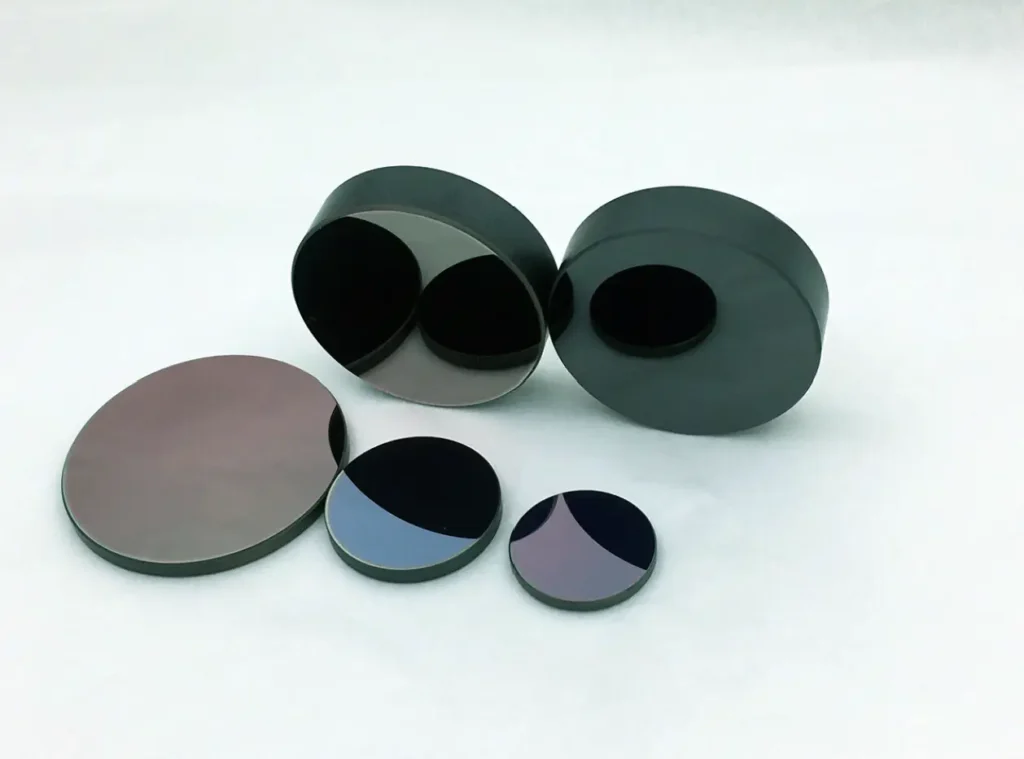
DLC Coatings for Enhanced Lens Performance
DLC Coatings (Diamond-Like Carbon Coatings) improve the durability, environmental resistance, and optical performance of infrared lenses. Furthermore, these advanced optical coatings protect Germanium and Chalcogenide lenses while maintaining high infrared transmission across LWIR and MWIR wavelength ranges.
DLC coatings provide:
- Scratch and Abrasion Resistance: Protect lenses from mechanical damage.
- Chemical Protection: Shield optics from moisture, dust, and environmental hazards.
- Maintained IR Transmission: Coatings are optimized for minimal reflectance in LWIR and MWIR bands.
DLC coatings significantly extend lens lifetime and enhance reliability in demanding environments, including defense, aerospace, maritime, and industrial applications. Learn more about our DLC Coating.
For engineers exploring alternatives to Germanium in thermal imaging systems, our detailed guide “Can Chalcogenide Replace Germanium?” provides practical insights and considerations.
Side-by-Side Comparison: Germanium vs Chalcogenide
| Feature | Germanium (Ge) | Chalcogenide (IRG) |
|---|---|---|
| Transmission (LWIR) | >90% with AR coating | >85–90%, depends on formulation |
| Thermal Stability | Excellent | Moderate, needs athermalization |
| Density | 5.3 g/cm³ | 4.0 g/cm³ (lighter) |
| Durability | High mechanical strength | Softer, needs protective coating |
| Cost | High | Moderate |
| Manufacturing | Precision polishing, CNC | SPDT, polishing; limited molding |
| Typical Applications | Long-range surveillance, industrial monitoring | Compact thermal cameras, cost-sensitive systems |
Germanium vs Chalcogenide: Which Material Should You Choose?
When choosing between Germanium and Chalcogenide for thermal imaging applications, you may also consider Germanium alternatives like IRG chalcogenide lenses that provide unique advantages in specific scenarios.
- Application Needs: For high-end LWIR cameras or harsh environments, Germanium is often preferred. Conversely, IRG lenses, one of the most popular Germanium alternatives, perform well in lightweight and compact systems.
- Budget & Volume: Chalcogenide reduces raw material costs and supports faster prototyping. Therefore, many OEM projects select IRG for cost-sensitive programs, making it an attractive Germanium alternative for bulk production.
- Temperature Variability: Germanium provides stable performance across temperature changes. In contrast, IRG may require athermalization in demanding environments, another important consideration when exploring Germanium alternatives.
- System Integration: Verify compatibility with detectors, coatings, and optical assembly requirements. Additionally, evaluate long-term manufacturing and maintenance considerations for both traditional Germanium lenses and its alternatives.
Pro Tip: Modern thermal imaging systems often combine both materials. Designers may use Germanium for high-precision imaging elements while incorporating IRG, a widely used Germanium alternative, for auxiliary or wide-angle optics.
Learn more about our LWIR lenses and infrared imaging applications.