
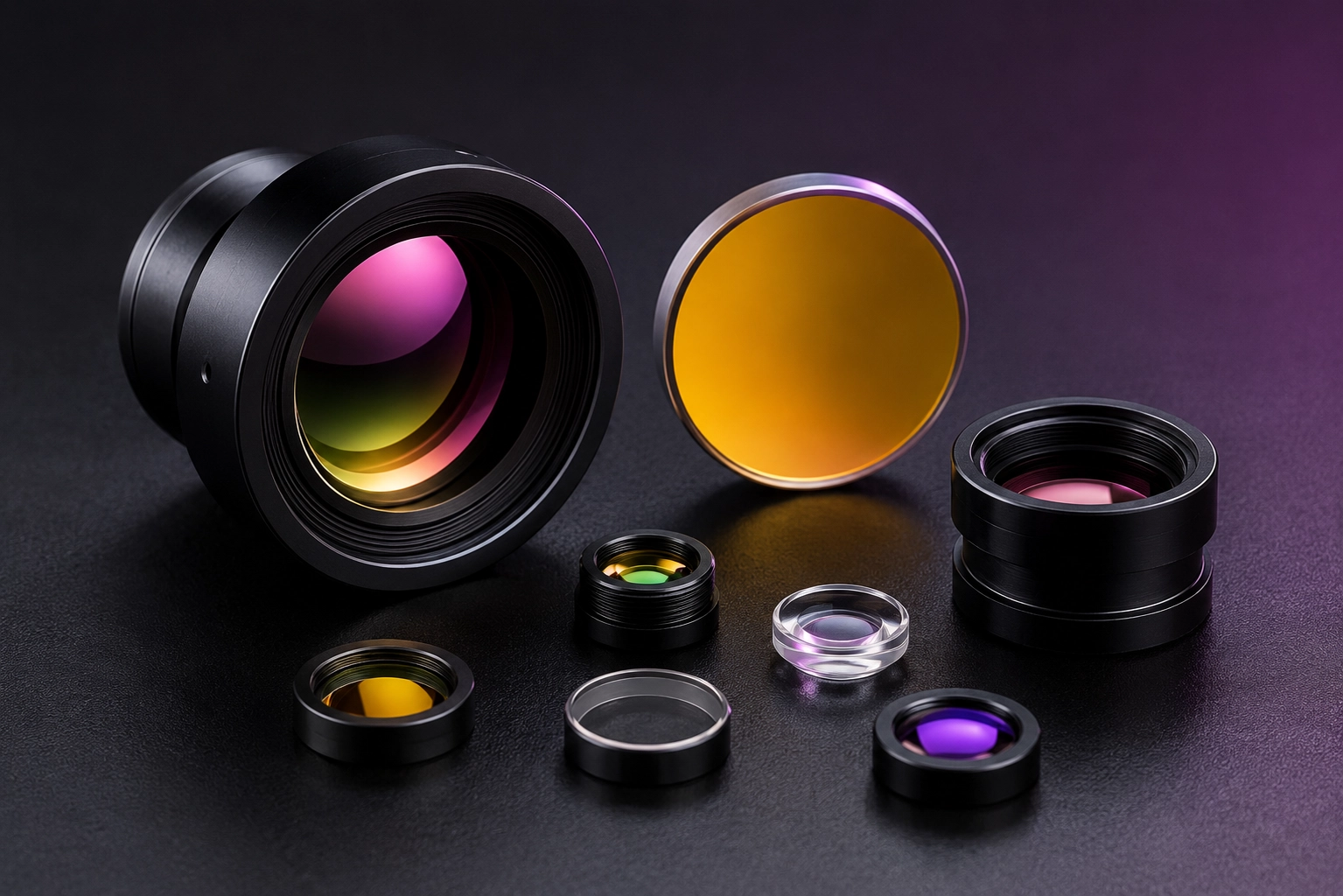
Infrared optics are one of the most important parts of any thermal imaging system. They determine how infrared energy is collected, focused, transmitted, and delivered to the detector.
For OEMs, system integrators, and engineering teams, selecting the right infrared optics is not only a technical decision. It also affects product performance, system integration, production stability, and long-term supply reliability.
At Shape Optics Technologies, we support OEM customers with infrared lenses, optical components, infrared modules, and custom optical design solutions for thermal imaging applications.
In addition, we help customers with material selection, lens design, coating, assembly, and system-level integration. Our goal is to help customers develop reliable infrared solutions for demanding markets such as defense, surveillance, industrial inspection, aerospace, medical imaging, and scientific instrumentation.
Why Infrared Optics Matter in Thermal Imaging Systems
Every thermal imaging system begins with the optical front end. The infrared lens or optical window collects infrared radiation from the target scene and focuses it onto the detector.
If the optical design is not optimized, the system may suffer from poor image quality, low transmission, focus shift, distortion, or reduced detection range.
Unlike visible-light optics, infrared optics must work with wavelengths that standard glass cannot transmit. Thermal imaging systems usually operate in the MWIR band from 3–5 µm or the LWIR band from 8–14 µm.
Therefore, these systems require special infrared materials such as Germanium, Silicon, Zinc Selenide, Zinc Sulfide, Sapphire, Calcium Fluoride, or Chalcogenide glass.
For OEM applications, infrared optics must also perform under real operating conditions. These conditions may include temperature changes, vibration, humidity, shock, coating durability, detector matching, mechanical mounting, and long-term production consistency.
What Makes Infrared Optics Different from Standard Optical Lenses?
Standard optical lenses commonly use visible glass materials. These materials work well for cameras, microscopes, laser systems, and imaging equipment operating in the visible or near-infrared range.
However, most visible glass materials cannot transmit mid-wave or long-wave infrared radiation effectively.
Infrared optics require materials with high transmission in specific IR wavelength bands. In addition, lens designers must consider how each material behaves when temperature changes.
In thermal imaging systems, small changes in refractive index, thermal expansion, or lens spacing can affect focus and image quality. As a result, OEM infrared lens design must consider both optical and mechanical performance.
A good infrared lens is not only about clear transmission. It must also maintain stable imaging performance across the full working environment.
Common Infrared Materials for Thermal Imaging
Different infrared materials offer different advantages. The best choice depends on the wavelength range, application environment, production volume, budget, and supply chain requirements.
| Material | Common Use | Key Advantages | Considerations |
|---|---|---|---|
| Germanium | LWIR lenses, thermal imaging optics | High refractive index, good LWIR transmission, compact lens design | Price volatility, export control risk, thermal focus shift |
| Silicon | MWIR optics, IR windows, laser optics | Lightweight, good mechanical strength, suitable for 3–5 µm | Not suitable for full LWIR transmission |
| Zinc Selenide | MWIR/LWIR windows and lenses | Broad IR transmission, useful for CO₂ laser and thermal systems | Softer material, requires careful handling |
| Zinc Sulfide | IR windows, domes, multispectral optics | Good environmental durability, suitable for harsh applications | Higher cost for some grades |
| Sapphire | Protective windows, harsh environments | Excellent hardness, high strength, good durability | Limited transmission in longer LWIR range |
| Chalcogenide Glass | Molded IR lenses, LWIR optics, compact lens systems | Moldable, good IR transmission, suitable for scalable production | Requires suitable coating and handling design |
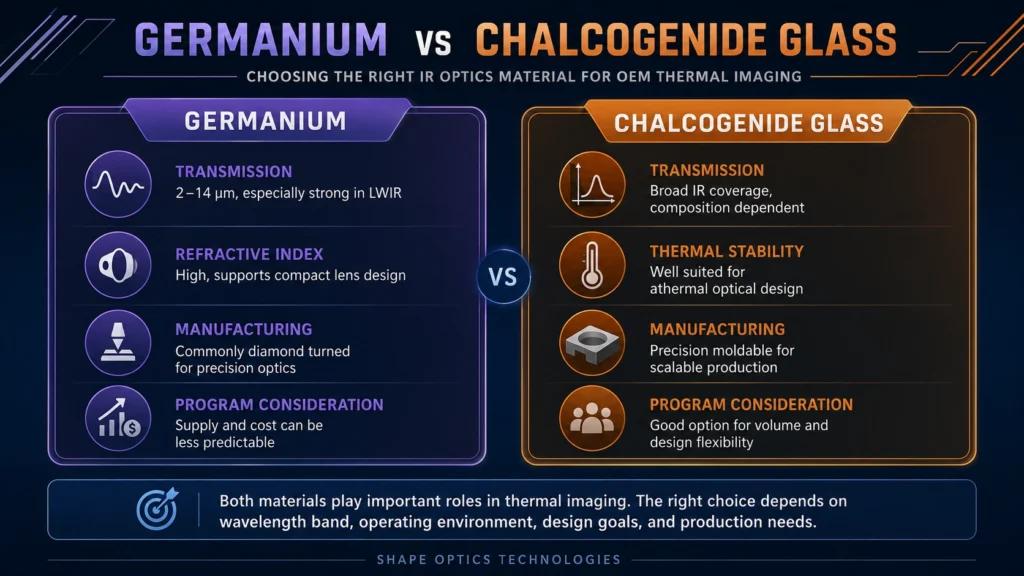
Germanium remains a widely used material for LWIR thermal imaging lenses. It offers strong LWIR transmission and supports compact lens design. However, Germanium may face price volatility, export control risk, and thermal focus shift.
Germanium vs Chalcogenide Glass for OEM Infrared Lens Design
Germanium has been widely used in thermal imaging optics for many years. It offers high infrared transmission in the LWIR range and allows compact lens designs because of its high refractive index.
For many existing thermal imaging systems, Germanium remains a proven and reliable choice.
However, Germanium also presents several challenges. Its optical performance changes with temperature, so engineers often need athermal design. In addition, material availability, price changes, and export-related constraints can affect long-term production.
Therefore, OEM programs should review these factors early in the design stage.
Chalcogenide glass is becoming more popular in infrared optics because it offers good infrared transmission and can be molded into complex lens shapes.
As a result, it is suitable for compact designs, aspheric lenses, lightweight systems, and higher-volume production.
For OEMs developing new thermal imaging products, Chalcogenide glass can offer advantages in scalability, design flexibility, and production consistency.
However, the best material still depends on the application, detector type, operating environment, and performance target.
To better understand the differences between these two materials, read our guide here.
Selecting the Right Spectral Band: MWIR or LWIR?
Thermal imaging systems commonly operate in either the MWIR or LWIR band. Each wavelength band has different strengths.
| Spectral Band | Wavelength Range | Typical Applications |
|---|---|---|
| MWIR | 3–5 µm | Long-range surveillance, cooled thermal cameras, high-temperature monitoring, gas detection, defense systems |
| LWIR | 8–14 µm | Uncooled thermal cameras, industrial inspection, security monitoring, night vision, predictive maintenance |
MWIR systems are often use cooled detectors. They are suitable for applications that require long-distance detection, high sensitivity, or gas imaging.
LWIR systems commonly use uncooled detectors. They are widely used in industrial inspection, security, surveillance, and commercial thermal imaging products.
Therefore, choosing the correct spectral band should begin with the application requirement.
Important questions include:
- What temperature range does the system need to detect?
- What detection distance is required?
- Will the system use a cooled or uncooled detector?
- Does the system need to work outdoors, indoors, or in harsh conditions?
- Is the priority image sensitivity, cost, size, or production scalability?
Answering these questions helps define the correct infrared lens design, material selection, coating specification, and mechanical structure.
OEM Applications of Infrared Optics for Thermal Imaging
Infrared optics support many OEM thermal imaging applications. However, each application has different design priorities.
Defense and Surveillance
Defense and security systems require infrared lenses with high sensitivity, stable focus, and reliable performance in harsh environments.
Common applications include thermal weapon sights, EO/IR systems, border surveillance, vehicle-mounted imaging, drone payloads, and long-range observation systems.
For these systems, optical design must consider vibration, shock, temperature range, sealing, coating durability, and detector matching.
Depending on the platform and detection requirement, OEMs may use MWIR cooled lenses or LWIR athermal lenses.
Industrial Inspection
Industrial thermal imaging systems help detect heat patterns, equipment faults, electrical issues, insulation defects, and process abnormalities.
These systems often operate continuously. Therefore, they must deliver stable image quality over time.
Infrared optics for industrial inspection should provide consistent transmission, good focus stability, and durable coatings.
LWIR lenses are commonly used for predictive maintenance and general thermal inspection. Meanwhile, MWIR optics may be used for high-temperature process monitoring.
Optical Gas Imaging
Optical gas imaging systems use infrared cameras to detect gases that are invisible to the human eye.
These systems require carefully selected wavelength bands, filters, coatings, and lenses. In many cases, MWIR optics are used to detect specific gas absorption features.
For OEM gas imaging applications, engineers must match the optical design with the detector, filter, gas absorption band, and environmental conditions.
Aerospace and UAV Imaging
Aerospace and UAV systems require compact, lightweight, and high-performance infrared optics.
In these applications, weight, size, vibration resistance, and thermal stability are critical design factors.
Athermalized infrared lenses are often required because they help maintain focus across changing altitude and temperature conditions.
Medical and Scientific Imaging
Infrared optics are also used in medical diagnostics, biomedical imaging, laboratory analysis, and scientific research.
These applications may require custom optical components, special coatings, tight tolerance control, or non-standard materials.
Key Factors OEMs Should Consider When Choosing Infrared Optics
Selecting infrared optics for thermal imaging should not depend on material alone. OEMs should evaluate the complete system requirement.
1. Detector Matching
The infrared lens must match the detector format, pixel size, image circle, and required field of view. A lens designed for one detector may not perform correctly with another detector.
2. Wavelength Range
The coating and material must match the working band, such as 3–5 µm, 8–12 µm, or 8–14 µm. Otherwise, poor wavelength matching can reduce transmission and image sensitivity.
3. Operating Temperature
Thermal imaging systems may operate in outdoor, industrial, aerospace, or defense environments. Therefore, athermal optical design is important when the system must maintain focus under changing temperatures.
4. Mechanical Integration
OEM systems require suitable mounting interfaces, flange distance, focusing mechanisms, sealing, and alignment control. For this reason, the optical design must work together with the mechanical structure.
5. Coating Performance
Infrared coatings improve transmission and reduce reflection loss. In addition, protective coatings such as DLC may be required for harsh environments, especially on external windows or exposed lens surfaces.
6. Production Volume
Prototype optics and mass-production optics may require different manufacturing approaches. For higher-volume production, engineers should consider manufacturability and repeatability from the beginning.
7. Supply Chain Stability
OEMs should review material availability, export restrictions, lead time, and long-term sourcing early in the project. After all, a technically strong design is not useful if manufacturers cannot produce it reliably throughout the full product lifecycle.
Why Optical Design Is Important for OEM Thermal Imaging Systems
Optical design is the foundation of thermal imaging performance. A well-designed infrared lens can improve image sharpness, reduce distortion, control stray light, and maintain stable performance across different environments.
At Shape Optics Technologies, we support customers from early-stage concept development to production-ready optical solutions.
Our optical design support can include:
- Custom lens design for MWIR and LWIR systems
- Material selection and optical simulation
- Athermal infrared lens design
- Detector and field-of-view matching
- Mechanical interface design
- Coating specification
- Prototype development
- Assembly and testing support
- Production optimization
By considering the complete system from the beginning, OEMs can reduce redesign risk, shorten development time, and improve product reliability.
From Infrared Optics to Complete Thermal Imaging Solutions
Many OEM customers do not only need a lens. Instead, they need a complete optical solution that can integrate smoothly into their thermal imaging system.
Shape Optics Technologies provides infrared optical components, lenses, modules, and custom assemblies.
Our capabilities include infrared lenses, optical windows, domes, filters, coatings, crystals, and thermal imaging modules.
Moreover, we work with customers across different industries to develop solutions for prototype, pilot production, and volume manufacturing.
This integrated approach helps reduce coordination between multiple suppliers. It also improves compatibility between optics, coatings, mechanics, and imaging modules.
Conclusion
Infrared optics for thermal imaging play a critical role in system performance, reliability, and product success.
For OEMs, the right lens or optical component must meet more than optical specifications. It must also support integration, production, environmental durability, and long-term supply stability.
Germanium, Silicon, Zinc Selenide, Zinc Sulfide, Sapphire, and Chalcogenide glass all have important roles in infrared imaging systems.
However, the best choice depends on the wavelength band, detector, application environment, production volume, and supply chain strategy.
Shape Optics Technologies supports OEM customers with infrared optics, optical design, custom infrared lenses, and thermal imaging solutions for demanding applications.
Whether you are developing a new thermal imaging system or improving an existing product, our engineering team can help you select, design, and manufacture the right infrared optical solution.
Frequently Asked Questions
What are infrared optics for thermal imaging?
Infrared optics for thermal imaging are lenses, windows, filters, and optical components designed to transmit and focus infrared radiation onto a detector. They are used in thermal cameras, infrared modules, surveillance systems, industrial inspection equipment, and scientific imaging systems.
What materials are commonly used for infrared lenses?
Common infrared lens materials include Germanium, Silicon, Zinc Selenide, Zinc Sulfide, Sapphire, Calcium Fluoride, and Chalcogenide glass. Each material has different transmission, mechanical, thermal, and cost characteristics.
What is the difference between MWIR and LWIR optics?
MWIR optics operate in the 3–5 µm wavelength range and are commonly used for cooled thermal cameras, long-range surveillance, gas detection, and high-temperature monitoring. LWIR optics operate in the 8–14 µm range and are widely used for uncooled thermal cameras, industrial inspection, security, and general thermal imaging.
Why is athermal design important for infrared lenses?
Athermal design helps an infrared lens maintain focus when temperature changes. This is important for outdoor, defense, aerospace, and industrial systems where the operating environment may vary significantly.
Can Shape Optics Technologies provide custom OEM infrared lenses?
Yes. Shape Optics Technologies provides custom infrared lenses, MWIR lenses, LWIR lenses, optical components, coatings, and infrared modules for OEM thermal imaging applications. We support optical design, prototyping, assembly, and production-ready solutions.
How should OEMs choose the right infrared optics supplier?
OEMs should choose a supplier with experience in optical design, infrared materials, coating technology, mechanical integration, and production control. The supplier should understand both optical performance and system-level application requirements.