
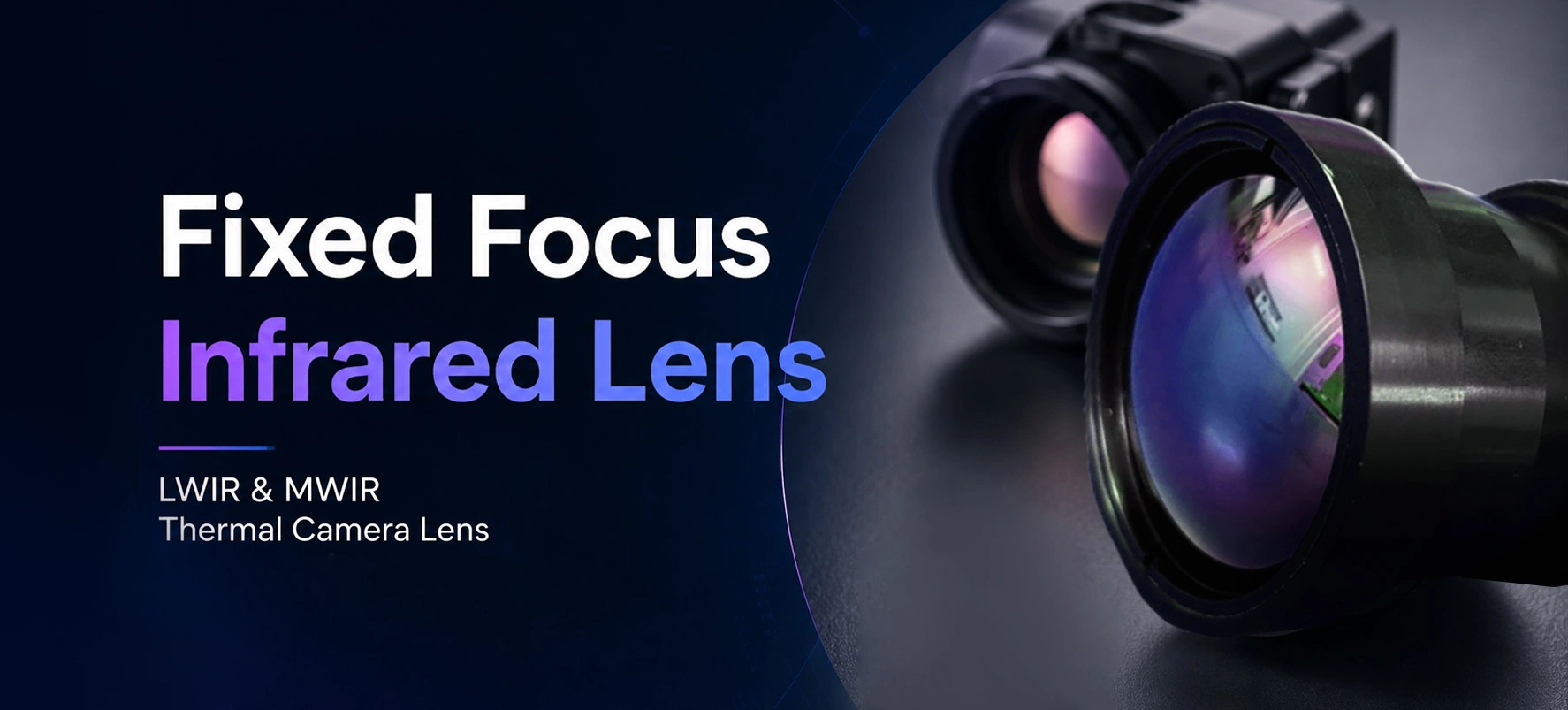
A fixed focus infrared lens is designed with a fixed focal length and preset focus position. It is commonly used in thermal imaging systems where the target distance and field of view are already known.
Fixed focus infrared lenses are often used in LWIR and MWIR thermal cameras, compact infrared modules, surveillance systems, industrial inspection equipment, fire detection systems, and OEM thermal imaging products.
What Is a Fixed Focus Infrared Lens?
A fixed focus infrared lens is an infrared lens with a fixed focal length and fixed focus setting.
Unlike a zoom lens, it does not change focal length. Unlike a motorized focus lens, it does not require electronic focus adjustment during normal use.
In simple words, a fixed focus lens is designed to provide a stable image at a specific focus range or working distance.
It is commonly used in thermal imaging systems where the camera view, target distance, and application requirement are already defined.
How Does a Fixed Focus Infrared Lens Work?
A fixed focus infrared lens collects infrared radiation from the target scene and directs it onto the detector inside the thermal camera or thermal core.
During production or system integration, the manufacturer adjusts the lens to the required focus position.
After setting the focus, the system normally operates without further adjustment.
As a result, the camera does not need a manual focusing mechanism or motorized focus control. This helps simplify the optical and mechanical design.
Therefore, fixed focus infrared lenses are especially useful for compact and stable thermal imaging systems.
Why Use a Fixed Focus Infrared Lens?
Fixed focus infrared lenses offer a simple solution when an application does not require zoom or frequent focus adjustment.
In addition, they can reduce mechanical and electronic complexity.
Main advantages include:
- Simple structure
- Compact size
- Lower system complexity
- No motorized control required
- Suitable for fixed viewing distance
- Easy integration with thermal cores
- Good choice for OEM thermal camera modules
For many thermal imaging applications, a fixed focus lens provides a practical solution when engineers already know the required field of view and target distance.
Common Applications of Fixed Focus Infrared Lenses
Fixed focus infrared lenses are widely used in thermal imaging systems.
Common applications include:
- Compact thermal cameras
- Handheld thermal imaging devices
- Industrial inspection systems
- Fire detection systems
- Security and surveillance cameras
- Perimeter monitoring
- Building inspection equipment
- Automotive thermal imaging
- Drone thermal cameras
- OEM thermal camera modules
- Infrared sensors and detection systems
For these applications, the lens usually needs to provide a clear thermal image within a known viewing range.
Fixed Focus Lens for LWIR Thermal Imaging
Fixed focus lenses are commonly used in LWIR thermal imaging systems.
LWIR lenses usually work in the 8–12 µm or 8–14 µm wavelength range and are often matched with uncooled thermal detectors.
Common detector formats include:
- 384 × 288 / 17 µm
- 640 × 512 / 12 µm
- 640 × 480 / 17 µm
- 1280 × 1024 / 12 µm
LWIR fixed focus lenses are suitable for compact thermal cameras, industrial inspection, outdoor monitoring, fire detection, and general thermal imaging systems.
Check available LWIR Fixed Focus Lenses
Fixed Focus Lens for MWIR Systems
Fixed focus lenses can also be designed for MWIR systems.
MWIR lenses usually work in the 3–5 µm wavelength range and are commonly used with cooled detectors.
MWIR fixed focus lenses may be used in applications such as:
- Scientific infrared imaging
- Long-distance monitoring
- High-sensitivity detection
- Aerospace and defense systems
- Custom infrared optical systems
The correct MWIR lens should be selected based on detector format, focal length, F-number, wavelength range, and application requirement.
Check available MWIR Fixed Focus Lenses
Fixed Focus Lens vs Other Infrared Lens Types
A fixed focus lens is one of several infrared lens configurations. Other common designs include manual focus lenses, motorized focus lenses, athermalized lenses, continuous zoom lenses, and dual field-of-view lenses.
| Lens Type | Simple Explanation | Common Use |
|---|---|---|
| Fixed Focus Lens | Focus is preset and normally not adjusted during use | Compact cameras, fixed monitoring, OEM modules |
| Manual Focus Lens | Focus is adjusted by hand | Inspection systems, testing, adjustable working distance |
| Motorized Focus Lens | Focus is adjusted electronically | Remote systems, surveillance platforms |
| Athermalized Lens | Designed to maintain focus across temperature changes | Outdoor thermal cameras, unattended systems |
| Continuous Zoom Lens | Focal length changes smoothly from wide to narrow view | Long-range observation, tracking, maritime |
| Dual FOV Lens | Provides two preset fields of view | Search and observation systems |
A fixed focus lens is suitable when the application needs a simple and stable imaging solution.
For outdoor systems with changing temperature, an athermalized fixed focus lens may be considered.
Main Specifications of a Fixed Focus Infrared Lens
When selecting a fixed focus infrared lens, customers should review the main specifications carefully.
| Specification | Example | What It Means |
|---|---|---|
| Wavelength Range | 8–12 µm / 3–5 µm | Shows whether the lens is LWIR or MWIR |
| Focal Length | 9.1 mm / 13 mm / 25 mm / 50 mm | Affects field of view and target distance |
| F-number | F/1.0 / F/1.2 / F/2.0 | Indicates light-gathering ability |
| Detector | 640 × 512 / 12 µm | Shows suitable detector resolution and pixel size |
| Field of View | Based on detector and focal length | Shows how much area the camera can see |
| Focus Range | Example: 2 m to infinity | Shows usable working distance |
| Focus Mode | Fixed focus | Focus is preset |
| Transmittance | Based on design | Shows how much IR energy passes through |
| Coating | AR / DLC / HD | Improves transmission or surface protection |
| Mount Type | Flange / thread / custom | Shows how the lens connects to the camera |
| Operating Temperature | Example: -40°C to +60°C | Important for outdoor and industrial use |
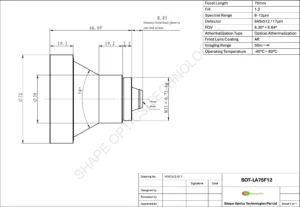
Example Fixed Focus Infrared Lens (75 mm / F1.2)
What Information Should You Provide Before Requesting a Quote?
To request a fixed focus infrared lens, it is helpful to provide:
- Wavelength range: LWIR or MWIR
- Detector resolution
- Pixel size
- Required focal length
- Required field of view
- F-number requirement
- Focus range or working distance
- Thermal core specification, if available
- Rear working distance or back focal distance
- Mechanical mounting interface
- Lens size limitation
- Coating requirement
- Operating temperature
- IP grade requirement, if any
- Application, such as thermal imaging, surveillance, industrial inspection, or fire detection
- 2D drawing or 3D STP file, if available
If customers already have a thermal core, they may provide the thermal core datasheet, 2D drawing, and 3D STP file. This helps us evaluate whether the fixed focus lens can match the detector, field of view, mechanical interface, and integration space.
Conclusion
A fixed focus infrared lens is a simple and reliable lens option for thermal imaging systems.
It is commonly used in compact thermal cameras, industrial inspection systems, security and surveillance cameras, fire detection systems, automotive thermal imaging, drone systems, and OEM thermal camera modules.
The right fixed focus lens depends on the wavelength range, detector resolution, pixel size, focal length, F-number, field of view, focus range, coating, and mechanical interface.
Shape Optics provides LWIR and MWIR infrared lenses, including fixed focus lenses, athermalized lenses, manual focus lenses, motorized focus lenses, continuous zoom lenses, dual field-of-view lenses, and custom infrared lens modules.
Contact us to discuss your fixed focus infrared lens requirements.
| Specification | Example | What It Means |
|---|---|---|
| Wavelength Range | 8–12 µm / 3–5 µm | Shows whether the lens is LWIR or MWIR |
| Focal Length | 9.1 mm / 13 mm / 25 mm / 50 mm | Affects field of view and target distance |
| F-number | F/1.0 / F/1.2 / F/2.0 | |
| Detector</td> | 640 × 512 / 12 µm | Shows suitable detector resolution and pixel size |
| Field of View | Based on detector and focal length | Shows how much area the camera can see |
| Focus Range | Example: 2 m to infinity | Shows usable working distance |
| Focus Mode | Fixed focus | Focus is preset |
| Transmittance | Based on design | Shows how much IR energy passes through |
| Coating | AR / DLC / HD</td> | Improves transmission |
| Mount Type | Flange / thread / custom | Shows how the lens connects to the camera |