
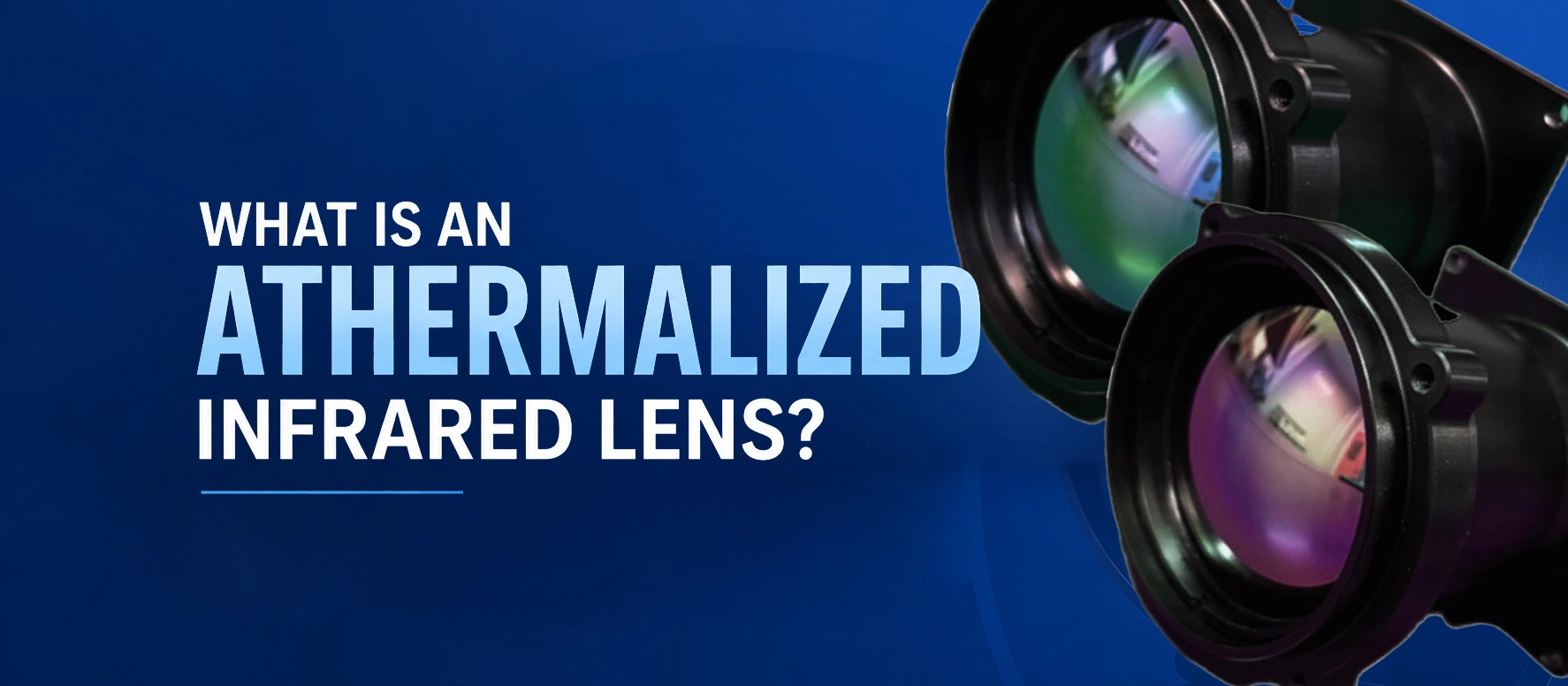
An athermalized infrared lens is designed to maintain stable focus when the operating temperature changes.
It is commonly used in LWIR thermal imaging systems, outdoor surveillance cameras, industrial monitoring equipment, vehicle-mounted systems, and other applications where the lens may experience different environmental temperatures.
What Is an Athermalized Infrared Lens?
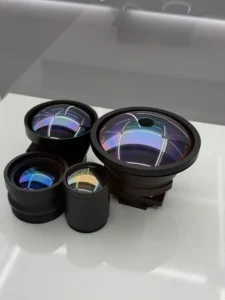
An Athermal Infrared Lens is a lens designed to reduce focus shift caused by temperature changes.
In thermal imaging systems, temperature changes can affect the lens material, housing, and optical performance. If the lens is not properly designed, the image may become less sharp when the environment becomes hotter or colder.
An athermalized lens helps maintain stable focus across a wider temperature range without frequent manual refocusing.
Why Is Athermalization Important?
Infrared cameras are often used outdoors or in environments where the temperature changes throughout the day.
For example, a thermal camera may operate in a cold morning, hot afternoon, or outdoor night environment. These temperature changes can cause the lens focus position to shift.
Athermal Lens design helps reduce this issue.
It is useful when the system needs:
- Stable image quality
- Less manual adjustment
- Outdoor operation
- Long-term monitoring
- Compact thermal camera design
- Reliable performance across temperature changes
How Does an Athermalized Lens Work?
An Athermal Lens is designed by considering both optical and mechanical factors.
The lens design may consider:
- Infrared lens material
- Lens element structure
- Lens housing material
- Mechanical spacing
- Thermal expansion
- Focus shift compensation
- Operating temperature range
The purpose is to allow the lens to maintain focus as much as possible when the temperature changes.
In simple words, the lens is designed so that the optical and mechanical changes can balance each other and reduce image defocus.
Common Applications of Athermalized Infrared Lenses
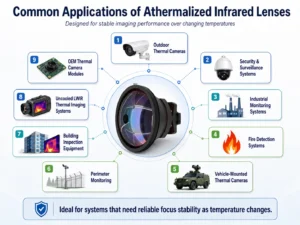
Athermal Infrared Lenses are commonly used in applications that require stable imaging performance over changing temperatures.
Common applications include:
- Outdoor thermal cameras
- Security and surveillance systems
- Industrial monitoring systems
- Fire detection systems
- Vehicle-mounted thermal cameras
- Perimeter monitoring
- Building inspection equipment
- Uncooled LWIR thermal imaging systems
- OEM thermal camera modules
For many fixed thermal camera systems, an athermalized lens is preferred because it helps reduce the need for manual focus adjustment.
Athermalized Lens for LWIR Thermal Imaging
Athermalized lenses are commonly used in LWIR thermal imaging systems.
LWIR lenses usually work in the 8–12 µm or 8–14 µm wavelength range and are often matched with uncooled thermal detectors.
Typical detector formats include:
- 384 × 288 / 17 µm
- 640 × 512 / 12 µm
- 640 × 480 / 17 µm
- 1280 × 1024 / 12 µm
The lens should be selected based on the detector resolution, pixel size, focal length, field of view, and operating temperature range.
Athermalized Lens vs Manual Focus Lens
An athermalized lens and a manual focus lens are used differently.
| Lens Type | Focus Method | Simple Explanation | Common Use |
|---|---|---|---|
| Athermalized Lens | Passive focus stability | Designed to maintain focus across temperature changes | Outdoor thermal cameras, fixed monitoring systems |
| Manual Focus Lens | User adjusts focus by hand | Focus can be adjusted manually when needed | Inspection systems, handheld devices, lab testing |
| Motorized Focus Lens | Electronic focus adjustment | Focus can be adjusted remotely or automatically | Remote systems, zoom lenses, surveillance platforms |
An athermalized lens is suitable when the system needs stable focus without frequent adjustment.
A manual focus lens is suitable when the user can adjust the focus when required.
A motorized focus lens is suitable when the system needs electronic or remote focus control.
Athermalized Lens vs Fixed Focus Lens
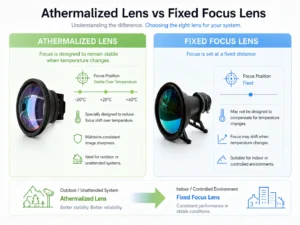
A fixed focus lens has a fixed focus position, but it may not always be designed to compensate for temperature changes.
An athermalized lens is also usually fixed in focus, but it is specially designed to reduce focus shift over temperature.
In simple terms:
- Fixed focus lens: focus is set at a fixed distance
- Athermalized lens: focus is designed to remain more stable when temperature changes
For outdoor or unattended systems, an Athermal Lens is often a better choice. Check on LWIR Athermal Lens
Common Specifications of an Athermalized Infrared Lens
When selecting an athermalized infrared lens, customers may need to review the following specifications:
| Specification | Example | What It Means |
|---|---|---|
| Wavelength Range | 8–12 µm | The infrared range the lens is designed for |
| Focal Length | 25 mm | Affects field of view and observation distance |
| F-number | F/1.0 | Indicates light-gathering ability |
| Detector Matching | 640 × 512 / 12 µm | Shows the suitable detector format |
| Field of View | 17.5° × 14° | Shows how much area the camera can see |
| Focus Mode | Athermalized | Designed for stable focus across temperature |
| Focus Range | 2.5 m to infinity | Shows usable focusing distance |
| Transmittance | >89% | Indicates how much IR energy passes through |
| Mount Type | Flange / thread / custom | Shows how the lens connects to the camera |
| Operating Temperature | -40°C to +60°C | Shows the working temperature range |
| Coating | AR / DLC / HD | Helps improve transmission or protection |
| IP Grade | IP67, if required | Useful for dust and water protection |
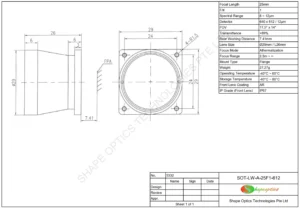
Example Athermalized Lens 25mm/F1
What Information Should You Provide Before Requesting a Quote?
To request an athermalized infrared lens, it is helpful to provide:
- Wavelength range: LWIR or MWIR
- Detector resolution
- Pixel size
- Required focal length
- Required field of view
- F-number requirement
- Focus range or working distance
- Operating temperature range
- Rear working distance or back focal distance
- Mechanical mounting interface
- Lens size limitation
- Coating requirement
- IP grade requirement, if any
- Application, such as surveillance, industrial monitoring, or vehicle-mounted thermal imaging
- 2D drawing or 3D STP file, if available
If you already have a thermal core, you may also provide the thermal core specification, 2D drawing, and 3D STP file. This helps us evaluate whether the lens can match your detector and mechanical interface.
Conclusion
An Athermal Infrared Lens is designed to maintain stable focus across temperature changes.
It is commonly used in LWIR thermal imaging systems, outdoor surveillance cameras, industrial monitoring systems, fire detection systems, vehicle-mounted thermal cameras, and OEM thermal camera modules.
Compared with a normal fixed focus lens, an athermalized lens is more suitable for applications where temperature changes may affect image focus.
Shape Optics provides LWIR and MWIR infrared lenses, including athermalized lenses, fixed focus lenses, manual focus lenses, motorized focus lenses, continuous zoom lenses, dual field-of-view lenses, and custom infrared lens modules.
Contact us to discuss your athermalized infrared lens requirements.