
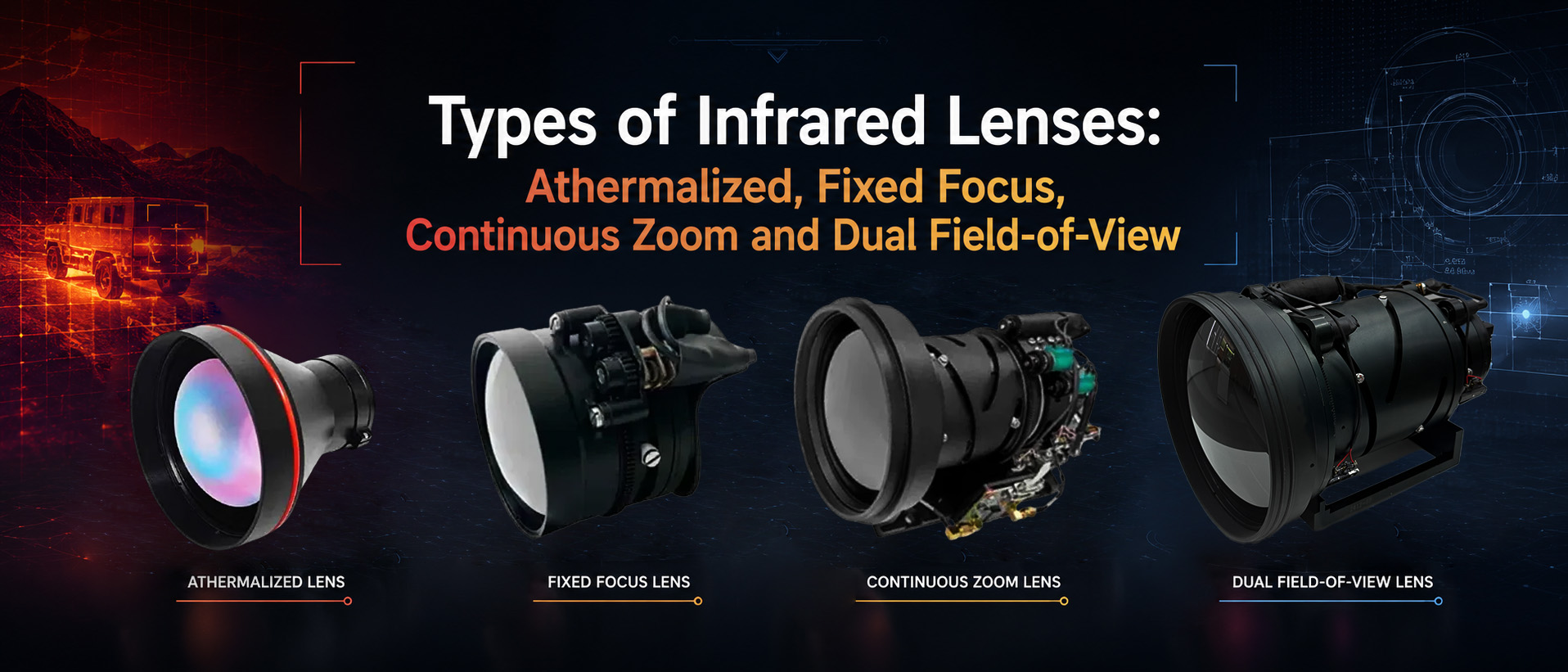
Infrared lenses are used in thermal imaging systems to collect infrared energy and focus it onto an infrared detector.
Different thermal camera applications may require different lens types. Some systems need a compact fixed focus lens, while others require motorized zoom, long-range observation, or stable performance across changing temperatures.
This article explains four common infrared lens types in a simple way: Athermalized lenses, Fixed Focus lenses, Continuous Zoom lenses, and Dual Field-of-view lenses.
Types of Infrared Lenses: Athermalized, Fixed Focus, Continuous Zoom and Dual Field-of-View
Infrared lenses are important parts of thermal imaging systems. They help collect infrared energy from a scene and focus it onto the detector, so the camera can create a thermal image.
However, not all infrared lenses are the same.
The right lens depends on the wavelength range, detector type, field of view, target distance, focus requirement, and operating environment.
Common infrared lens types include:
- Athermalized lenses
- Fixed focus lenses
- Continuous zoom lenses
- Dual field-of-view lenses
These lens types are commonly used in LWIR and MWIR thermal imaging systems.
What Is an Athermalized Infrared Lens?
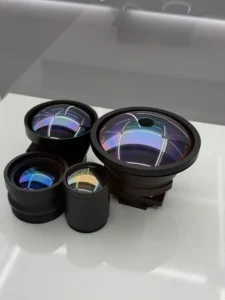
An Athermalized infrared lens is designed to maintain stable image performance when the temperature changes.
In outdoor environments, the temperature can change between day and night or across different seasons. These temperature changes may affect the focus of a normal lens.
An Athermalized lens helps reduce this issue by keeping the image more stable over a wider temperature range. These infrared lenses are especially useful in outdoor thermal imaging systems that experience significant temperature changes.
Common applications:
- Outdoor thermal cameras
- Security and surveillance systems
- Automotive thermal imaging
- Industrial monitoring
- Defense and aerospace systems
- Unattended thermal imaging equipment
Why choose an Athermalized lens?
An Athermalized lens is useful when the camera needs to work reliably in changing temperature conditions without frequent refocusing.
What Is a Fixed Focus Infrared Lens?
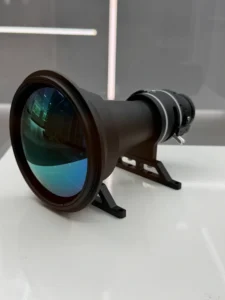
A Fixed Focus infrared lens is designed with a fixed focal length and focus position.
It does not require regular focus adjustment during use. This makes it simple, compact, and easy to integrate into thermal camera systems. Among the different types of infrared lenses, Fixed Focus models are often selected for compact and cost-sensitive applications.
Fixed Focus lenses are commonly used when the viewing distance and application are already known.
Common applications:
- Thermal cameras
- Industrial inspection
- Fire detection systems
- Building inspection
- Security monitoring
- Compact infrared devices
Why choose a fixed focus lens?
A Fixed Focus lens is a good choice when the system needs a simple, stable, and cost-effective infrared lens solution.
What Is a Continuous Zoom Infrared Lens?
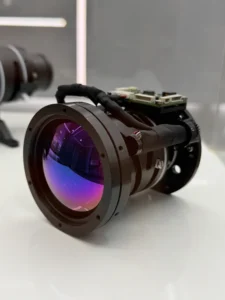
A Continuous Zoom infrared lens allows the user to change the focal length smoothly within a certain range.
For example, a lens may zoom from 20 mm to 120 mm. At the shorter focal length, the camera can see a wider area. At the longer focal length, the camera can observe a smaller area in more detail.
In simple words, a continuous zoom lens helps the camera switch from wide-area observation to closer target viewing. This type of infrared lens provides greater viewing flexibility than a fixed focus thermal imaging lens.
Common applications:
- Long-range surveillance
- Border monitoring
- Maritime observation
- Search and rescue
- Defense systems
- Tracking applications
- Long-distance thermal imaging
Why choose a continuous zoom lens?
A continuous zoom lens is useful when the system needs flexible viewing, target search, and closer observation in one lens module.
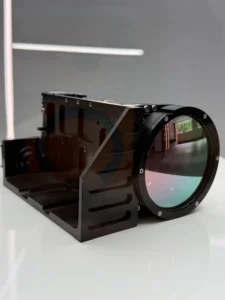
What Is a Dual Field-of-View Infrared Lens?
A Dual Field-of-view lens provides two viewing modes: a wide field of view and a narrow field of view.
The wide field of view helps users scan a larger area. The narrow field of view helps users observe a target in more detail.
Unlike a Continuous Zoom lens, a Dual Field-of-view lens usually switches between two preset fields of view instead of zooming smoothly across a full range. These infrared lenses are commonly selected when users need both target search and detailed observation without a full continuous zoom mechanism.
Common applications:
- Surveillance systems
- Target observation
- Maritime monitoring
- Border security
- Defense optical systems
- Thermal imaging platforms
Why choose a Dual Field-of-view lens?
A Dual Field-of-view lens is suitable when the system needs both wide-area viewing and closer target observation, but does not require continuous zoom.
Simple Comparison Table
| Lens Type | Main Function | Simple Explanation | Common Use |
|---|---|---|---|
| Athermalized Lens | Stable focus over temperature changes | Helps maintain image quality when the environment changes | Outdoor thermal cameras, surveillance, industrial monitoring |
| Fixed Focus Lens | Simple fixed viewing setup | Focus and focal length are usually fixed | Compact thermal cameras, inspection, fire detection |
| Continuous Zoom Lens | Smooth zoom range | Allows wide view and closer view within one lens | Long-range surveillance, tracking, maritime observation |
| Dual Field-of-View Lens | Two viewing modes | Switches between wide FOV and narrow FOV | Target search, observation, defense, monitoring |
Which Infrared Lens Type Should You Choose?
The best lens type depends on the application.
You may consider an Athermalized lens if the camera needs to operate outdoors or in changing temperature environments.
You may consider a Fixed Focus lens if you need a simple and compact thermal imaging solution.
You may consider a Continuous Zoom lens if the system needs flexible observation from wide view to close-up view.
You may consider a Dual Field-of-view lens if the system needs two preset viewing modes, such as wide-area search and narrow-view observation.
What Information Should You Provide Before Requesting a Quote?
To recommend a suitable infrared lens, it is helpful to provide:
- Wavelength range: LWIR or MWIR
- Detector type: cooled or uncooled
- Detector resolution
- Pixel size
- Required focal length
- F-number
- Focus type: fixed, manual, motorized, zoom, or dual FOV
- Operating temperature
- Application environment
- Mechanical interface or mounting requirement
- Quantity and project stage
Example Specification for Infrared Lens Module
| Item | Example Specification |
|---|---|
| Lens Type | LWIR continuous zoom lens |
| Wavelength Range | 8–12 µm |
| Detector Type | Uncooled LWIR detector |
| Detector Resolution | 640 × 512 |
| Pixel Size | 12 µm |
| Focal Length | 20–120 mm |
| F-number | F/1.1 |
| Focus Type | Motorized focus |
| Zoom Control | Motorized zoom |
| Application | Thermal imaging, surveillance, long-range observation |
| Interface / Mount | Thread / Flange / Custom |
| Quantity | 1 set / prototype / batch production |
Conclusion
Athermalized lenses, Fxed Focus lenses, Continuous Zoom lenses, and Dual Field-of-view lenses are commonly used in infrared and thermal imaging systems.
Each lens type has a different purpose. Fixed focus lenses are simple and compact. Athermalized lenses are suitable for changing temperature environments. Continuous zoom lenses provide flexible viewing. Dual field-of-view lenses provide two preset viewing modes for search and observation.
Shape Optics provides LWIR and MWIR infrared lenses, including Athermalized lenses, Fixed Focus lenses, Continuous Zoom lenses, Dual Field-of-view lenses, Motorized focus lenses, and custom infrared lens modules.
Contact us to discuss your infrared lens module requirements.